Google IO 2026: What Your C-Suite Needs to Know (AI Mode Google Guide UPDATED)
Resources
Share
This article has been written and updated by Carrie Rose, The CEO and Founder of Rise at Seven and Matt Holmes, the Executive Director - of Integrated Strategy at Rise at Seven as of May 2026
🚨 Google just announced what it calls the biggest upgrade to the Search box in more than 25 years 👇
A year ago Google launched AI Mode - and I (Carrie) said "AI mode is no longer just a switch users can turn on or off, but a tab which users can use as their default - with hints that it will take over the whole SERP". Since then it has surpassed one billion monthly users, with queries more than doubling every quarter since launch and yesterday... it really did take over the whole SERP.
Yesterday (19th May 2026) Google IO happened - the biggest upgrade to the search box in more than 25 years. And within about 20 minutes of the keynote, our inbox started filling up with the same question from senior marketers: should we be worried?
Honestly? It depends on how you’ve been playing the game.
Please note: this is going to impact every type of marketer - brand marketers, social media marketers, organic marketers and paid! And in this post I am going to share in very simple terms what this means, what C suites should know. Learn how our AI SEO agency services help brands improve visibility across ChatGPT, Google AI Overviews and other generative search platforms.
This isn't just a Google update, or another algorithm update. It’s a message to marketers about how consumers will now discover your brand at each stage of the journey. It turns search from a public directory into a deeply personalised assistant - and if you’re not ready for that shift, your brand could slowly and literally disappear from the search journey without anyone noticing, not even you!
Stop being so hard to find.
If your exec team hasn’t had the conversation yet about what this means, here it is.
TL;DR: Search is no longer about keywords or even just content. It’s about people.
AI Mode doesn’t just give answers - it knows you as a person. It’s pulling data from Gmail, Calendar, Maps, YouTube, your past searches, your shopping receipts, and probably that one weird Google Doc from 2017. It’s building a personalised profile of you and serving content that fits your preferences, your habits, and your intent.
So what does that actually look like?
Hate onions? Google won’t show you recipes with onions.
Got a Paris trip coming up? You’ll get travel tips near to the hotel you've booked, not general search results.
Always running at 10pm? You’ll see gyms and routines that match your schedule.
Been talking about breakups in your email? It might suggest new hobbies or therapy.
This is no longer a one-size-fits-all search engine. This is your search engine.
The way consumers find you - has drastically switched to 1-1 hyper personalised results and Googles latest update in May 2026 is moving customers more and more to conversational search - killing off single keywords.
This isn’t a technical breakdown for your SEO team - there are plenty of those. This is for the CMO, the CEO, the Commercial Director who needs to understand in really basic and commercial terms what actually changed, why it matters, and what to do about it.
What Google announced - the latest Google IO 2026 update to the search bar/box
The search box has been rebuilt for the first time in 25 years. That’s Google’s own framing, not ours. Meaning the way people search and find you WILL change.
Here’s what’s actually different:
AI Mode is now the global default. We predicted this last year in THIS AI mode Google guide and now its come true. Powered by Gemini 3.5 Flash. It’s not a tab users opt into - it’s the experience. Already over a billion monthly active users worldwide.
So how are people using the search box differently on Google?
The search box itself works differently. It expands as you type, pushing you toward longer, more descriptive queries. It suggests how to ask better questions - not autocomplete, genuinely active guidance. It takes text, images, files, videos, Chrome tabs as inputs. The three-word keyword as the primary unit of search intent is being retired.
In simple terms - users used to search "car insurance" or "dresses" - but now the search box dynamically expands to give you space to describe exactly what you need, in detail, with pain points, with emotion.
Is keyword research dead? Its certainly harder to track as the users search behaviour goes long tail.
And not only this... but what happens is: Search now remembers your thread. One AI Overview becomes a conversation - ask a follow-up, stay in AI Mode, keep going deeper. Whereas before, if you go back to the search bar and search - it thought its a whole new topic.
Underneath all of this - personalisation at a scale most brands aren’t ready for. AI Mode pulls from Gmail, Calendar, location history, YouTube watch patterns, past searches, shopping behaviour. This basically means if i was to search for something and you searched for something our answers would be completely different, completely personalised based on what AI mode knows about me and my buying decisions and needs.
It’s filtering results based on who you are, not just what you typed. The SERP isn’t a public directory anymore. It’s already decided what’s relevant before you finish your sentence.
Why this is a commercial problem, not an SEO problem
93% of queries in AI Mode end without a click to an external website.
Let that one land. That’s not a traffic dip. That’s the model most digital marketing programmes are built on - search → click → site → convert - breaking down structurally.
Google used to be a neutral directory pointing people to the best answer. It’s not anymore. It is the answer. And if your brand only shows up at the click stage, you’re invisible to the majority of AI Mode users. The influence is happening in the synthesis. In who the AI cites. Before anyone ever reaches your site.
Here’s the flip side of that though. Brands cited in AI Overviews earn 35% more organic clicks and 91% more paid clicks compared to brands that aren’t. Being in the answer reverses the CTR penalty entirely.
So the game isn’t ranking anymore. It’s being the source the AI trusts enough to quote.
There’s a second problem worth naming. Because AI Mode personalises so aggressively, if someone has never engaged with your category - no clicks, no searches, no adjacent behaviour Google can detect - you may simply not appear. Even for queries you should own. You’re outside their filter bubble. You’re not being deprioritised. You just don’t exist.
This is a new kind of invisibility. Not algorithmic suppression. Not a penalty. Just absence. The user's search history simply never created the conditions for you to appear - and AI Mode had nothing to work with.
That’s why the category leadership conversation matters so much right now.
Second to this: Information agents are coming. This is the one that keeps me thinking. Google is launching background agents that monitor the web 24/7 on your behalf - no query needed. You tell it what matters, it surfaces updates. Available to subscribers this summer. The direction of travel is clear though: the act of searching is becoming optional.
What category leadership actually means
We’ve built our strategy practice around this. It’s behind the Category Leaderboard, behind how we think about demand generation, behind how we frame growth conversations with every client.
Category leadership isn't the brand with the biggest budget. It's not even the brand with the largest market share.
To own a category, you have to be two things: found and wanted.
Discoverable - showing up when people search, whether that's Google or AI. And... In demand - the brand people are actually asking/searching for by name when it comes to that category
We've partnered with Ahrefs to measure exactly that.
That’s not a content strategy. It’s brand and search working as one thing - which they always should have been, honestly.
Search is now hyper-personalised
So what is AI Mode, exactly?
Google’s search results are now hyper-personalised - and I mean creepily personal. It’s no longer just about where you’re located. It’s about who you are, what you’ve done, what you’re likely to want, and what you haven’t tried yet (and probably won’t unless someone challenges your habits).
It’s pulling data from:
Gmail (e.g. flights booked, receipts, personal convos)
Google Calendar (events, plans, routines)
Search history
YouTube watch patterns
Google Maps & location history
Shopping behaviours
Your fit bit activity (remember Google owns fitbit and health data too)
This isn’t a search engine. This is your search engine.
Search has become intent-aware, mood-aware, and even routine-aware.
What This New AI Search Era Means for Marketers
(And what the smart ones are doing about it)
Google’s AI Mode flips the model: instead of search being a window into the internet, it’s now a mirror reflecting the user back at themselves.
The SERP is no longer a neutral ground. It’s filtered by everything Google knows about the individual - from their calendar to their cravings, their inbox to their intentions.
So what’s changing?
1. The Funnel Has Collapsed Into Moments
There’s no longer a neat path from awareness to consideration to conversion. Searchers are dropping in at random stages, driven by calendar events, TikTok trends, or what they had for lunch yesterday.
Tactical suggestion:
Build modular content that works no matter where someone is in the funnel. One blog post should answer a high-level intro question and go deep for those already ready to buy.
Use intent layering - match content to emotional cues like “I’ve just broken my phone” vs “I’m researching phone insurance.”
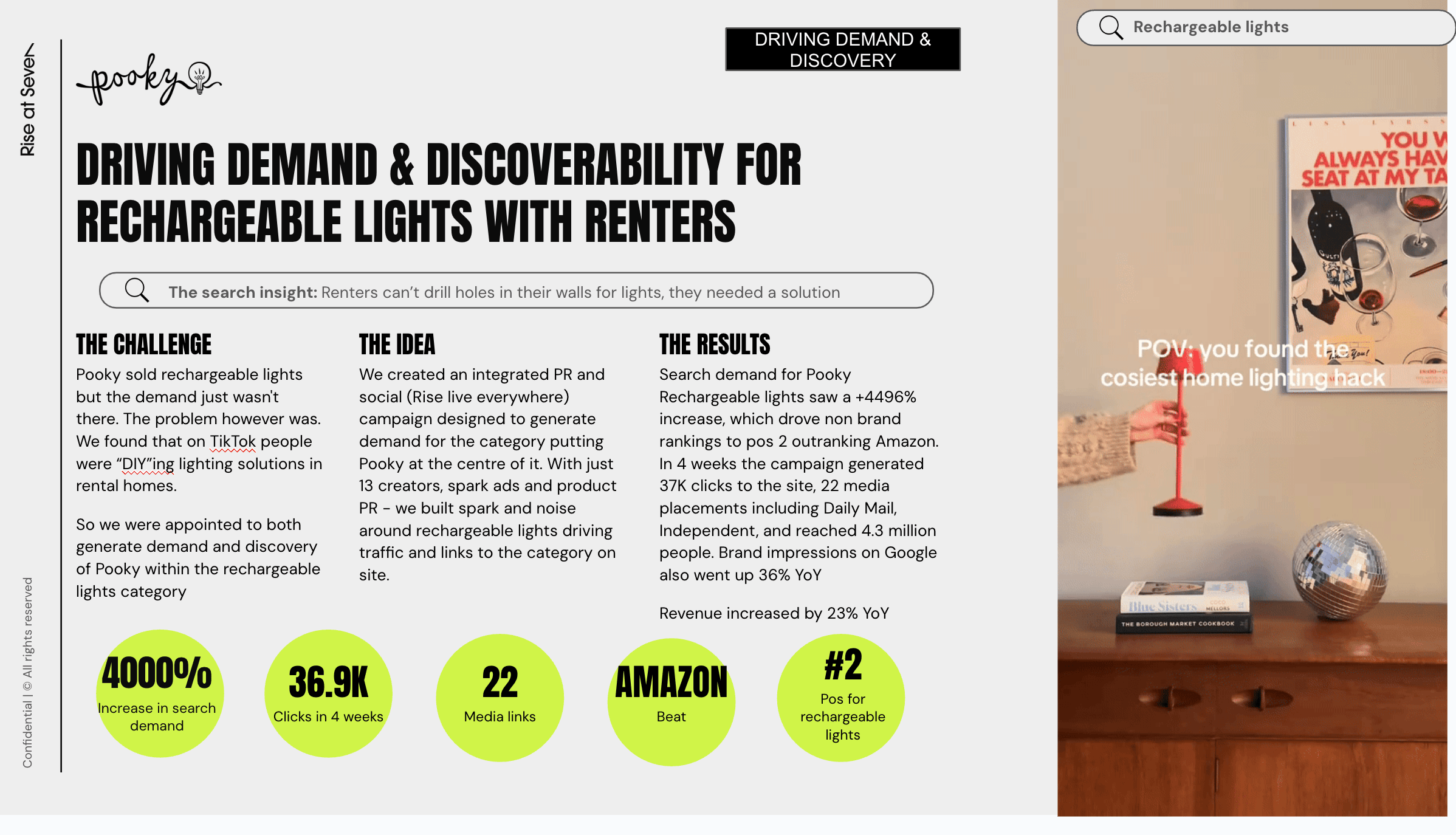
Case Study example of us using intent layering for Pooky
With Pooky, they sell lighting. But the emotional cue/problem one of their audience types has is “not allowed to drill holes in my rented property”. They needed a solution. The product we had was "rechargeable lights”
We targeted renters who can’t drill holes - a specific segment struggling to find lighting solutions. We created demand around rechargeable lighting using TikTok, Spark Ads and PR. We optimised creator content on socials to rank for the problems and solutions, we built links into the onsite category through 22 media placements and the result…
Someone might not be searching “cheap running shoes.” They’re Googling “my knees hurt when I run” - and they’re doing it at midnight. That’s where brand opportunity now lives.
Being relevant to someone > being visible to everyone
In an algorithmically filtered world, brands must narrow their audience - not widen it.
Knowing the problems you solve for what type of audiences, where they're searched (platforms), with what intent is a key piece of strategic work that needs to occur now before any SEO work begins. We at Rise at Seven have a dedicated upfront product available for any brand looking to for this level of insight before they invest in content work.
Tactical suggestion:
Expand your keyword research to include emotional and behavioural queries — “can’t sleep before big day,” “feeling burnt out,” “how to cancel plans without guilt.”
Optimise for the why, not just the what.
3. Your Brand Might Not Even Appear - discovery is going to be competitive unless you're already in their orbit
If someone hasn’t engaged with your category or product type before, Google’s AI might not show you at all. You’re outside the user’s personal filter bubble. The AI won’t even consider you unless it already has signals you're relevant. This might make NEW/start up brands very hard to be discovered.
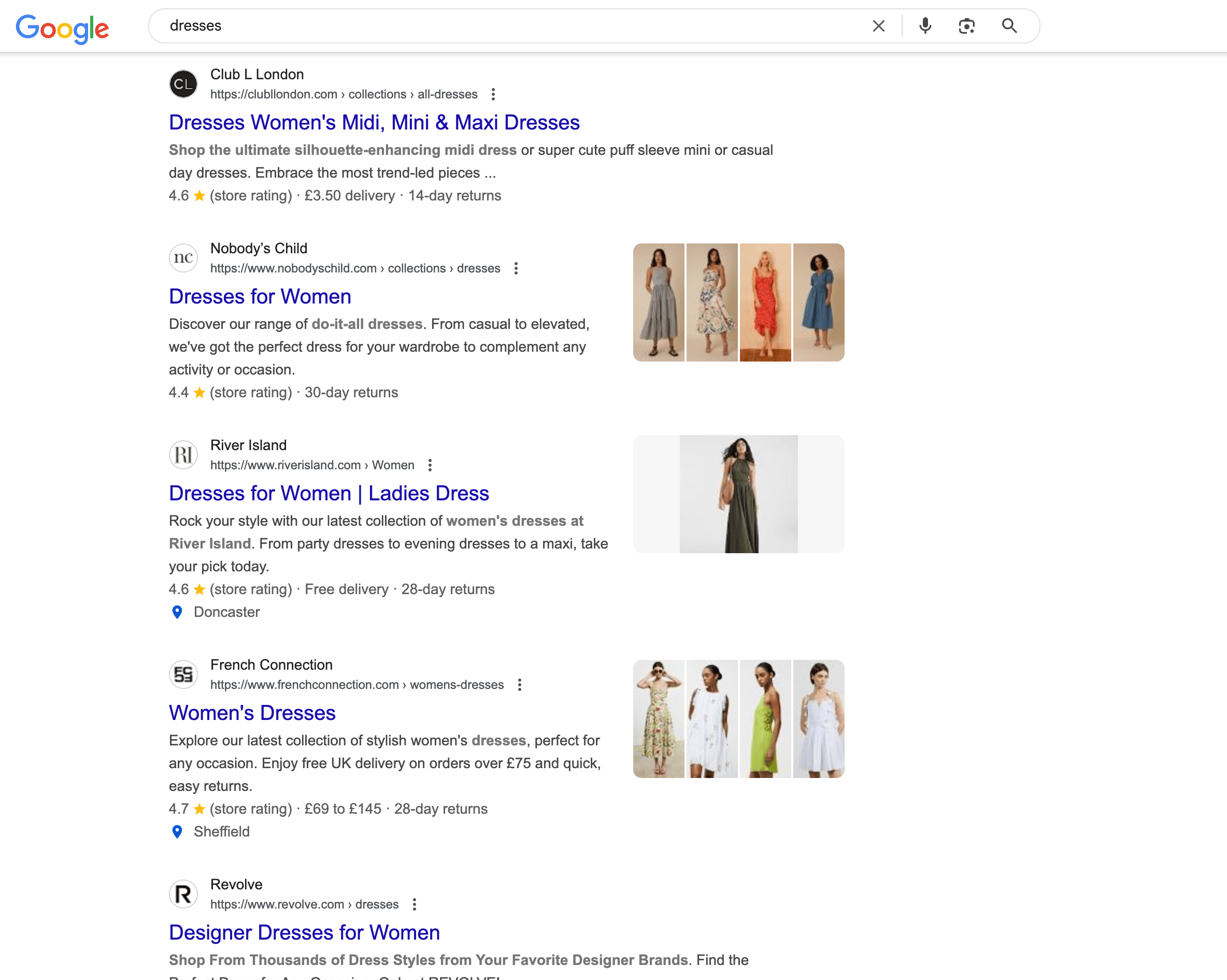
It was a lot easier to rank new brands, like nobody's child or Club L London. With really strong optimisation it's easy to rank for highly competitive terms like dresses. But it's getting hard now. These brands (who i've never bought from) might not appear in my search but Google knows I don't buy from here and rarely click here too
Tactical suggestion:
Invest in discovery tactics outside of Google — e.g. TikTok SEO, Reddit presence, and UGC seeding on platforms like Pinterest and YouTube Shorts.
Borrow visibility to get discovery faster - Collaborate with influencers who already live inside your audience’s bubble and drag your brand into it. Rent their eyeballs, borrow their audience
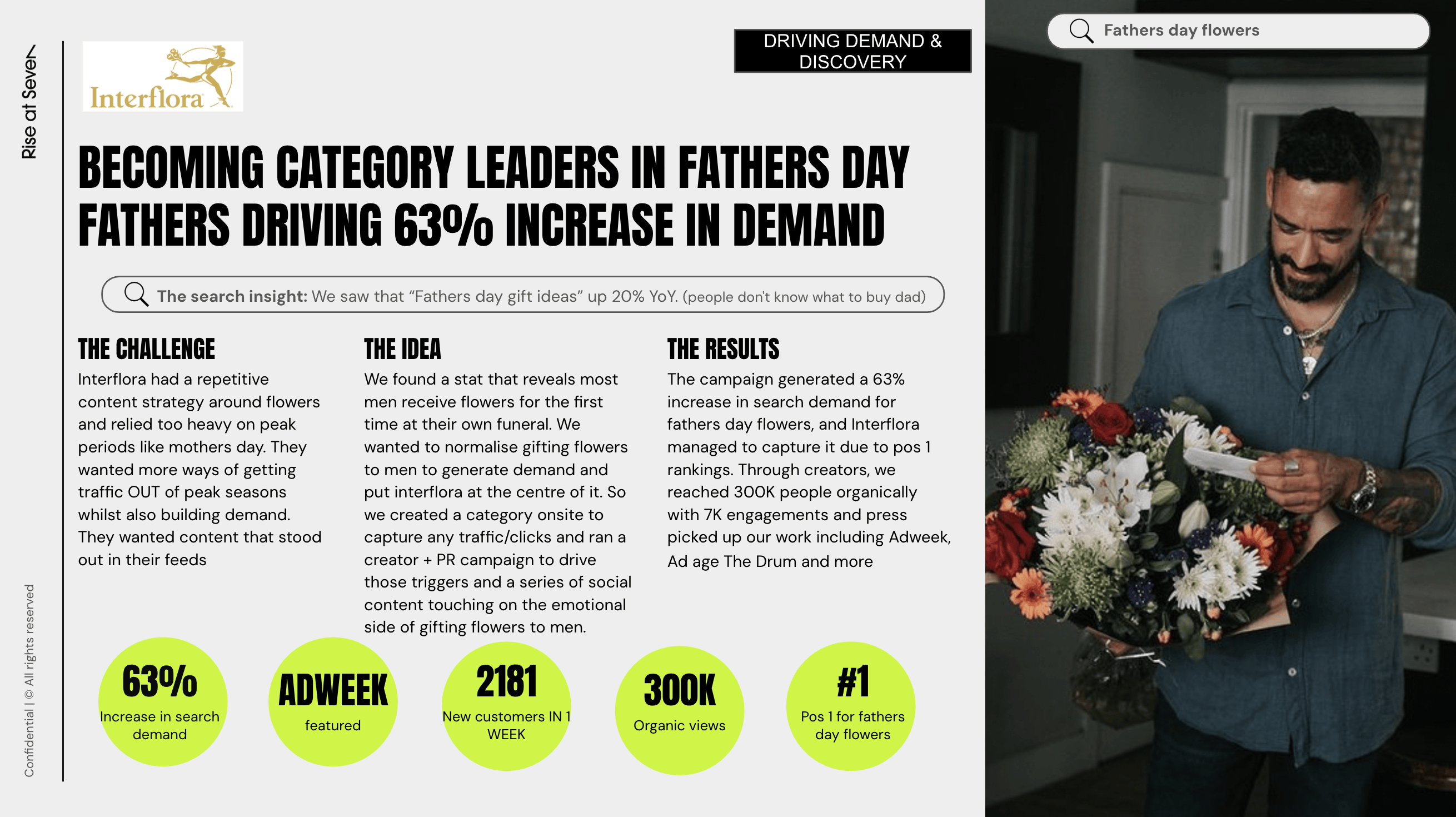
Case Study: Interflora
Interflora wanted to go after new audiences, which in this new world of search will be a big strategic goal for many brands in my opinion. In order to go after new audiences, you have to be discovered where you would not typically be discovered.
We found that “fathers day gifts” were more searched for than mothers day gifts, people knew what to get mum more than dad. The options for dad were nearly always beer, socks, or a mug but what else can you get? Well we found a stat that men receive flowers for the first time at their own funeral, so we wanted gifting flowers to men on fathers day to be normalised.
We created a new onsite category, ran a creator + PR campaign, and ranked #1.
📈 Result: 63% increase in search demand. Featured in Adweek, The Drum, and Ad Age.
4. SERPs Are Now UX Battlegrounds
Even if you do appear, you’re fighting to be the source Google summarises — not just to rank. Recommendations (written, links, visual) is a key metric to track now, impressions and share of SERP/real estate will be key.
Tactical suggestion:
Format content with clear, structured answers, lists, schemas, and pull quotes to get as much real estate as possible
Use FAQs with crisp answers, direct headlines, and semantic variety — “How long do induction hobs last?” vs “When do I need to replace my induction hob?”
5. Click-through Rates Are Shrinking — So Influence Happens on the SERP
People might get all they need from the AI overview. Your job is to be the source it’s pulling from.
Tactical suggestion:
Monitor which pieces of your content are appearing in AI Overviews.
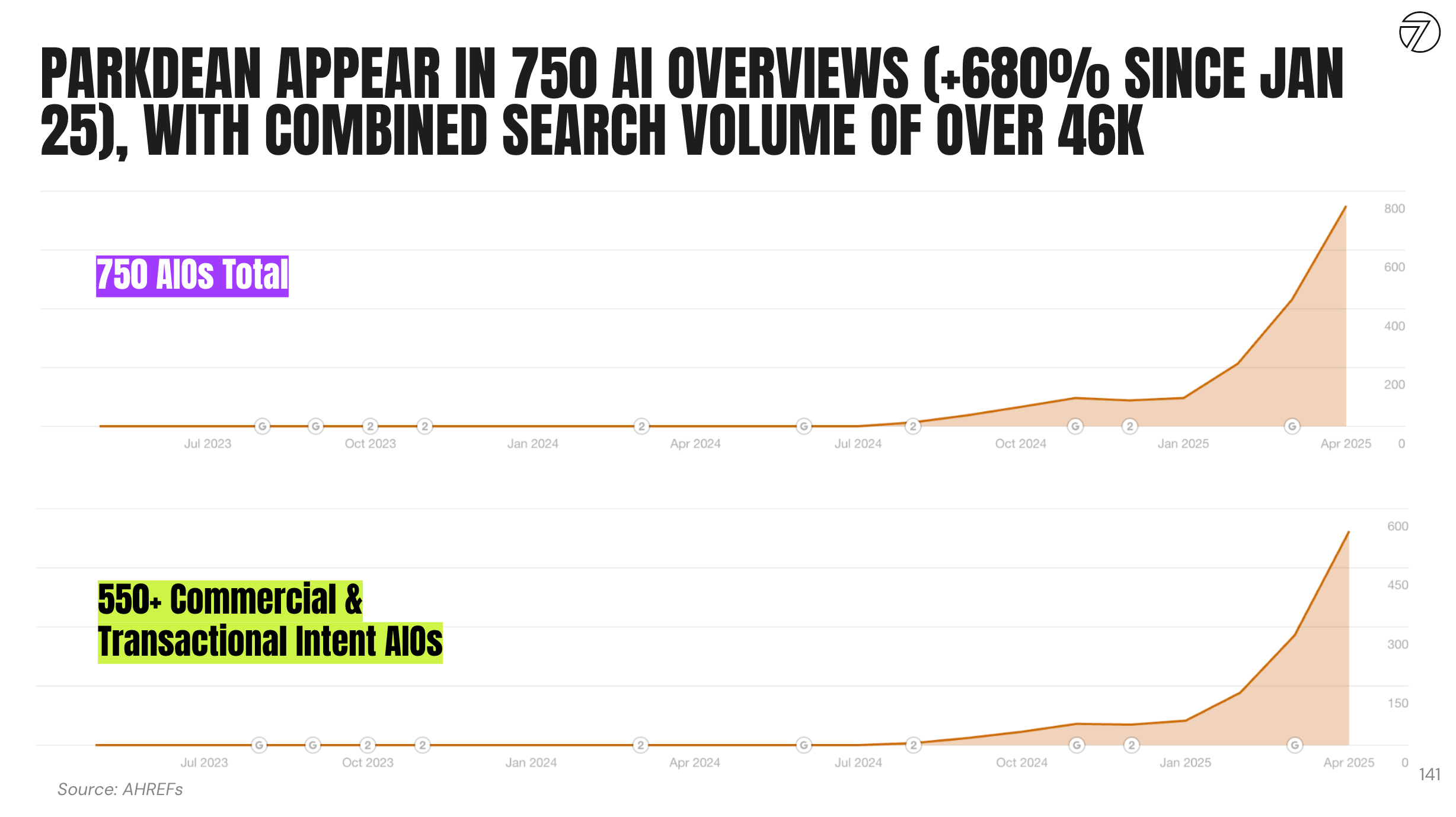
Here you can see for a client of ours we rank in 750 AI overviews which is up 680% since January for a combined search volume of 46K. We are tracking this by commercial intent also where 550 of them are commercial (hint - we are going after commercial intent keywords which have a higher chance of click through than informational)
Reverse engineer your competitors’ content that gets pulled into these summaries — what are they doing structurally? What’s their tone? Are they citing others?
6. Search Will Now Reflect Real-World Routines
Someone’s calendar says “wedding in Cornwall” — and now their search results include Cornwall hairdressers, suit rental deals, and beach bars.
Tactical suggestion:
Create content clusters that map to life events: weddings, job interviews, moving house, breakups, dry January, marathon season.
Build “searchable life moments” guides tied to your product — “What to pack for ‘Malaga’”, “Dinners for when your inbox screams burnout.”
Case study:
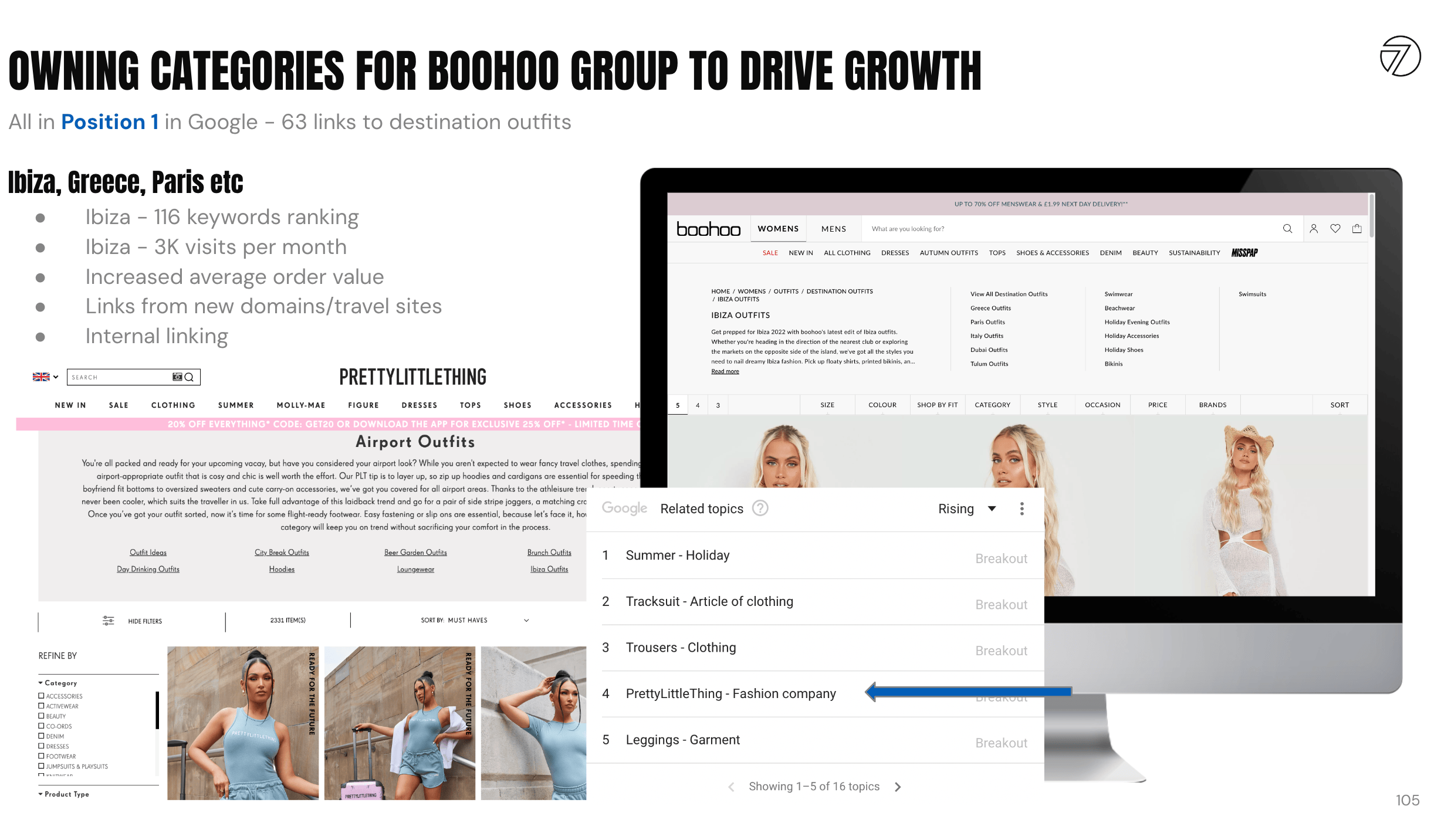
Heres what we did to match real world routines for a leading fashion brand: Pretty Little Thing, Boohoo & Nasty Gal
We created a destination outfit strategy targeted specifically to tying our products to travel destinations. We knew people wanted bikinis for Ibiza, or midi dresses for Greece, but in order to build semantic relevance for Google and humans, we built out dedicated categories. This was pushed to press for external authority signals also getting 63 links and as a result ranks for most destination terms.
And we did it again, with airport outfits.
Case Study: PrettyLittleThing We built a new category around “airport outfits” based on trending search volume and Pinterest interest. It wasn’t just about joggers — it was about why people buy them. 📈 Result: Ranked #1 in UK & US. 136 links. 7K monthly traffic. Category ranks for 379+ keywords.
7. Your Audience Segments Are Now Individuals and We Now Have To Train Google
Every content piece, PR placement, forum mention, social post, and category page you create feeds semantic signals into Google and LLMs. You are teaching the internet what you're about, who you’re for, and who you’re not.
This is huge for brand marketers. Your audience data — interests, price sensitivity, diet preferences, values — should fuel search strategy.
Because soon, the question won’t be: “How do we rank for this term?” But instead: “Will AI think we’re even relevant to this person?”
So forget audience buckets. Google’s AI sees people as individuals, not personas. It's important now than ever to understand consumers on a whole new level
Tactical suggestion:
Create audience-first data strategies. Run your own panels, sentiment tracking, social listening, and user journey mapping. Know them better than Google does.
Localise not just for location - but for mood, culture, time of day, and mindset.
Speak to one of our experts about our audience first strategies
8. AI Will Prioritise Authority, Not Just Relevance
If you and your competitors both answer a query, the AI Overview will likely pull from whoever is more trustworthy, cited, or “linked” through data networks.
Tactical suggestion:
Double down on E-E-A-T: Add author bios, expertise validation, references, and third-party quotes. Think less “blogger” and more “source.”
Build entity strength - make sure Google sees your brand as a recognised authority in the space through schema, Wikipedia pages, Google Knowledge Panels, and Wikidata links.
9. Your Competitor Might Be a Forum Post or Reddit Thread
AI Overviews love summarising user opinions — not just brand-owned content.Shared media (what other people are saying is going to be super important about what appears in the search results now).
Tactical suggestion:
Seed your brand into Reddit discussions, Quora threads, and niche forums. Start conversations and answer questions organically.
Mine these platforms for the real language people use — then reflect it in your content so the AI sees the same phrasing and matches it.
10. This Is the Best Time to Rewire Your Strategy Search is now happening outside Google too
The brands that panic over traffic dips will waste time fixing the old system. The ones that reorient around people will win this next era.
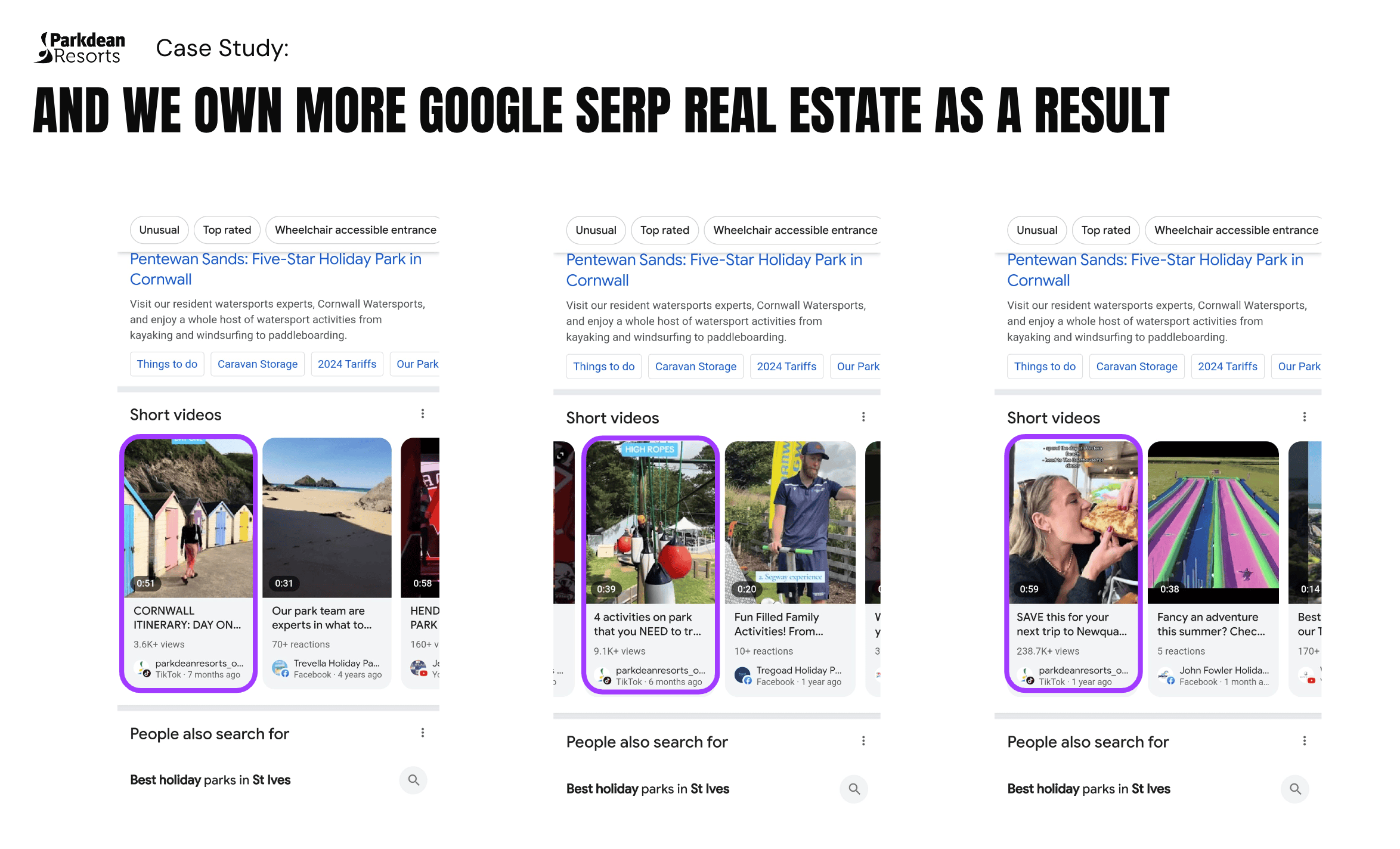
Consumers are searching on TikTok, YouTube Shorts, Pinterest, and more. And guess what? Google is indexing these short-form results directly in SERPs.
Example case study here:
Tactical suggestion:
Audit your content by asking: Does this piece speak to a real person, in a real moment, with real context? If not, kill it or fix it.
Build for channels where users don’t rely on Google: TikTok, newsletters, group chats, DMs, in-store touchpoints. Diversify your entry points.
WARNING
SEOs will try to be everything to everyone - and get penalised
Here’s our prediction: Marketers will start stuffing their sites to be “the best for every type of person.” Budget, luxury, vegan, gluten-free, minimalist, maximalist — all at once.
But AI will sniff this out. If customer reviews say “not the best for pregnant people” or “not great on a budget,” Google will believe them over you.
💬 Shared media (what others say) is becoming one of the biggest ranking signals but you can control this with creators, well optimised content.
EEAT, Authority, Brand and Link signals still matter
In a world where AI is choosing between 3 near-identical pieces of content, authority becomes the tie-breaker. And E-E-A-T (Experience, Expertise, Authoritativeness, Trustworthiness) is more important than ever.
Google needs to know: “Who’s more trusted in this category?” “Who’s the source journalists cite?” “Whose name appears in the topically relevant press?”
In a world where everyone’s using AI to churn out the same regurgitated content, Google (and AI Overviews) need something to decide who to trust.
Think of it like this: If both Tesla and Polestar create content on “how long EV batteries last,” who’s getting pulled into the Overview box?
It’s not about who wrote it better. It’s about:
Who’s linked to by top-tier publishers in automotive, tech, and energy verticals
Who’s consistently cited in context
Who has real semantic authority around the category
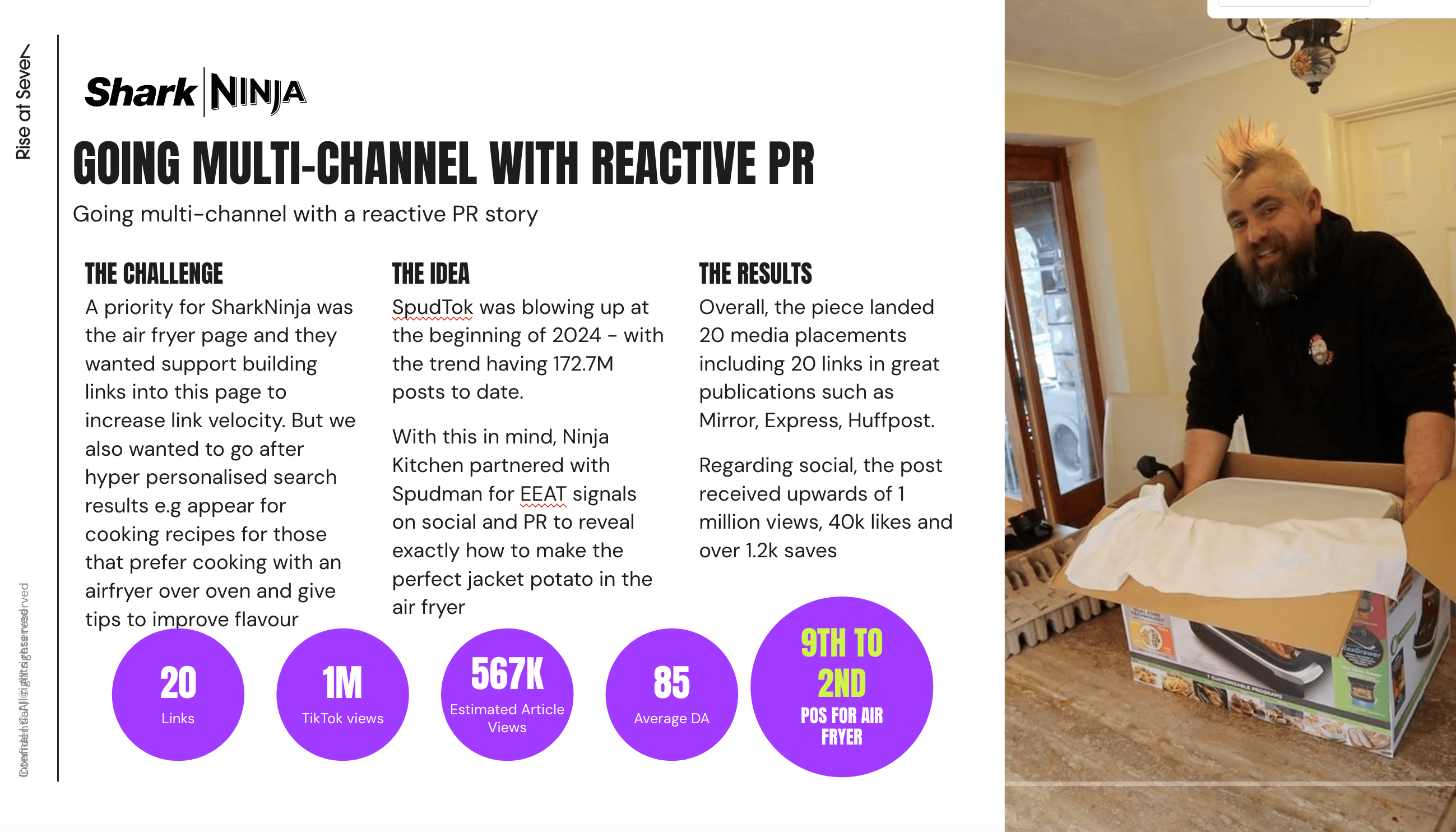
Case Study: SharkNinja - Cooking Up Authority Signals with Spudman
Objective: Boost visibility, search rankings, and product authority for SharkNinja’s air fryer range
Challenge: SharkNinja was launching a new air fryer model just as air fryer search demand exploded — but the SERPs were saturated. Major retailers dominated with price-led messaging, and AI Overviews were starting to summarise user-generated content (like Reddit and TikTok) instead of linking to branded pages.
To rank - and be referenced by AI -SharkNinja needed to:
Be relevant in culture
Own the category semantically
Get high-authority, contextually relevant links to the product page
Insight: We found that on “SpudTok” (the side of TikTok obsessed with potatoes and air fryer recipes), one creator was blowing up: Spudman — a street food vendor known for jacket potato hacks, with millions of engaged fans. He had cultural traction, audience credibility, and search interest all on the rise.
Strategy: We partnered with Spudman to create reactive, search-led content that tied SharkNinja to “how to cook the perfect jacket potato in an air fryer.”
We then:
Dropped educational + entertaining videos across YouTube Shorts and TikTok
Created on-site how-to content around “best air fryer jacket potato recipe”
Seeded the story to national and lifestyle press with angles like “You’ve been cooking jacket potatoes wrong”
Results:
📈 20+ press placements (The Sun, Daily Mail, Metro) with links directly to product landing pages
🥔 1M+ organic video views across TikTok and Shorts
🔗 Avg DA of 85 across all backlinks
🔍 Ranking jump from position 9 to position 2 (now at pos 1) for high-volume air fryer terms
🎯 Featured snippet win and increased inclusion in AI Overviews
Why this worked in the AI era:
We generated real-world cultural authority, not just keywords
The content had E-E-A-T value - Spudman is seen as an expert in his space
The links were contextually perfect (air fryer > potato cooking > SharkNinja product)
The campaign built semantic strength around air fryer terms and usage moments (jacket potatoes being a top search during winter)
Final Thought: This Is a New Search Era
And we’ve been ready for it.
At Rise, we’ve never chased Google. We’ve chased consumers.
We’ve built audience-first content, semantically trained AI, and launched discovery campaigns that tap into culture, behaviour, and emotion.
We’ve diversified channels. Optimised beyond SEO. Owned categories that didn’t even exist yet.
And we’ll keep doing it - while the rest of the industry panics about traffic drops.
TL;DR: What Your C-Suite Needs to Do Now
✅ Rethink what SEO is. It's now audience, authority, and behaviour-based.
✅ Invest in audience insight tools - not just keyword research. You need to know your people better than Google does.
✅ Stop trying to be everything for everyone. Own your niche, and build semantic authority around it.
✅ Diversify into TikTok SEO, YouTube intent, and emerging search surfaces. SERP volatility is only increasing.
✅ Be the signal. In a world of AI-generated answers, you need to be the source it's quoting.
Need help rebuilding your search strategy?
We’re already there. Let’s talk.
Written By
Carrie Rose
Founder
Wed 20 May
Resources
CEO & Founder of Rise at Seven, and my job is to be out in the market and see which way the wind is blowing in the next 1, 2, 5 or 10 years time and bring that home to my team and clients. I lead the vision of the agency across the UK & US.