Opinion Piece: The SEO vs GEO debate is making our industry look stupid
Share
We are some of the smartest people in the marketing industry, and right now we look stupid.
AI search/discovery has kicked off an identity crisis in marketing. A debate!
And whilst many think there's this "new way of doing marketing" and everyone needs to learn it FAST...
I'm going to share a really strong opinion that it's actually always been this way, nothing's changed - it's just exposing which ones are clear, consistent and credible - to then be worth recommending.
Here's why...
There are people who work in brand marketing STEALING our lunch money right now. YES REALLY.
They're taking search budgets, they're acting like they know how to create the most discoverable brands. This is our space, our game, we own this. But why is it SEO is losing?
Whilst everyone is debating "what to call it - SEO or GEO - and is GEO just good SEO" - the problem isn't what we call it, it's that we're (still) asking the wrong question.
I'm not seeing enough SEOs ask - ok, what do we ACTUALLY need to do to be clear, consistent and credible? Worthy enough to be recommended by AI?
I am seeing studies left, right and centre telling us things we SHOULD already know ...
That AI prefers others' recommendations (which is why Reddit is the most cited platform) (well yeah, surely we can guess that?)
That media/earned media/PR drives citations/influences them (we knew this, we just forget that media holds HUGE trust)
That AI loves fresh content less than 13 weeks old (My mum could have told you that)
That reviews and real opinion impact citations (Common sense - or is that not common?)
I mean it, I'm sounding harsh, but sometimes I think, come on guys - ask ourselves. What do we want to see? Where would we trust recommendations?
Did we really need to spend THOUSANDS of £/$ to tell us things we should know?
We as consumers are DONE with brand heavy, keyword stuffed, manipulated content we just want someone real to tell us "whats the best skin care for dry skin?" Or "the best airfryer to get that isn't going to cost more than my mortgage?"
And the fact is - not one CMO has ever asked me whether we do "SEO or GEO." They ask me one question: why is my competitor showing up in ChatGPT and I'm not?
And while the industry argues about acronyms on LinkedIn, that question is going unanswered.
We've seen this film before
Every time the ground shifts, our industry does the same thing. Invents a new three-letter acronym. Launches a wave of tools. Sells the same audit with a new cover slide. I get why. New acronym = new budget line = new pitch. I run an agency. I understand the commercial temptation better than most.
We did it with voice search. We did it with mobile. Half the "GEO agencies" that appeared in the last 18 months are SEO agencies that changed their homepage headline. I said it in this video here - they're just chasing keywords because that's what SEO has always done
But here's my problem with it: GEO, as it's being sold, is mostly SEO tactics with worse measurement. Schema. Crawlability. Content structure.
"Optimise your headings so the LLM can extract them." That's not a new discipline. That's technical SEO wearing a lanyard that says AI on it. It is - and we know it!
And the bits of "GEO" that ARE genuinely new? They're not optimisation at all.
The important part - You can't optimise your way into being recommended. Avoid entity misalignment!
This is the bit the industry keeps missing.
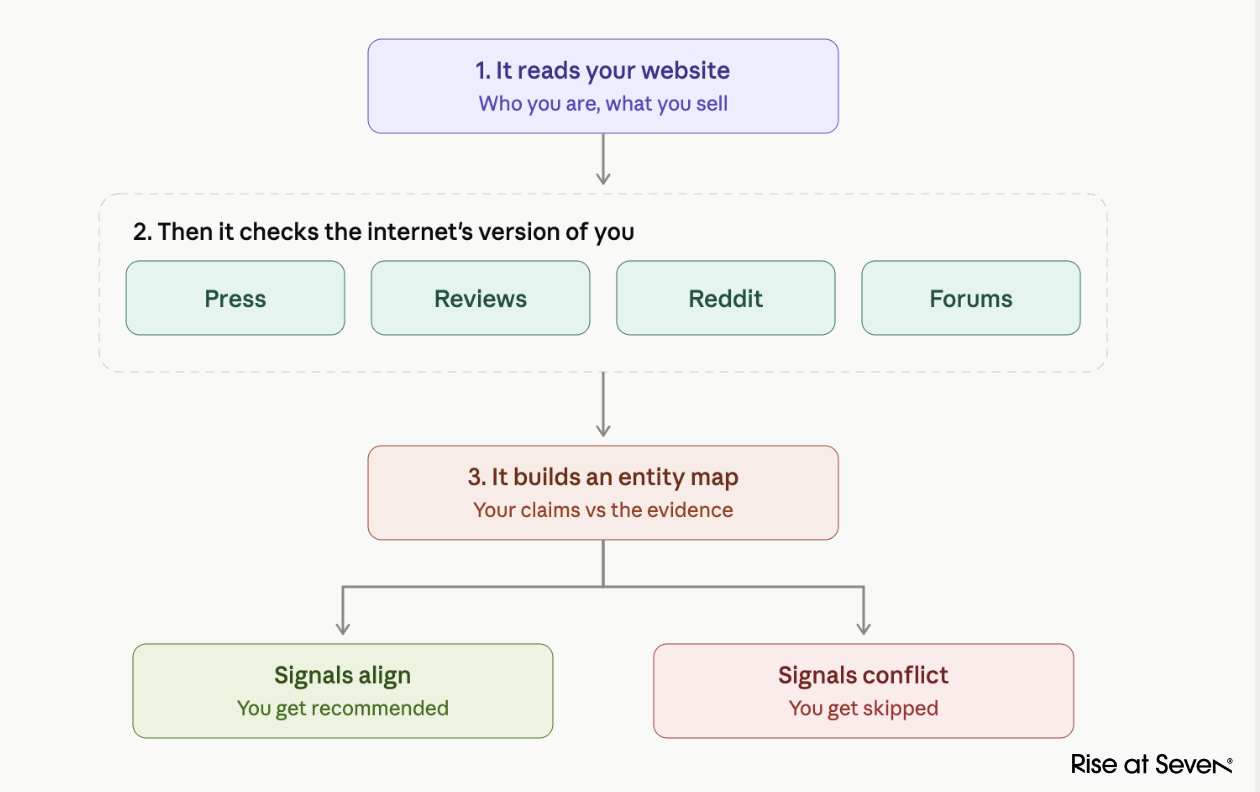
AI search doesn't just just read your website. I have a theory (unbacked) that AI STARTS by reading your website. Getting an understanding who you are, what you sell, and how knowledgable you are about it.
Then... it reads what everyone ELSE says about you to see if those signals match.
It then compares it to Reviews. Press coverage. Reddit threads. Comparison articles. Community discussions. Forums. It takes all of that evidence and forms an entity map.
If in that entity map, theres misalignment on who you are: you wont be recommended
If theres signals on your website about what you sell/do that aren't elsewhere: you won't be recommended
If you are saying one thing about why your product IS the one to buy and others are saying other things: E.g "were luxury vs their cheap/low value" you wont be recommended.
Which means the question is no longer "how do I rank?"
It's "what does the internet believe about my brand - and is it consistent, credible, and everywhere?"
That's not an optimisation problem. That's an integration problem. The SEO & content team have been writing things on websites for 20+ years without knowing what is the brand, PR, social, email team saying about this offsite.
It's also an EARNED MEDIA problem. AND a brand problem. It's a PR problem. And frankly, it's a product problem - because if your product is average, the machines will find that out faster than any customer ever did.
We track this daily across our clients. The brands winning AI visibility aren't the ones with the best structured data. They're the ones with the most brand demand and the strongest consistent footprint of independent, third-party evidence. The ones people actually talk about. Demand drives discovery. It has for years. AI has just made it impossible to ignore.
YOU need to get clear about how you are, and who you're NOT (more importantly).
To win, and be recommended...
You need to get VERY clear about who you are and who you aren't.
You need to get clear on who your audience is and who your audience isn't
You need to get clear on what problem you want to solve and which ones you don't
Because this SEO industry has spent their careers going after every keyword, and every audience, whichever has the highest volume. I said it in my AI mode guide for the C -suite here Volume doesn't matter anymore, its about quality and intent. If someone wants cheap flights - Emirates don't have a chance! But thats ok. Because they shouldn't even want to!
And yes that's a brand strategy thing.
My advice: your AI strategy should be a brand/search strategy. I'm not saying brand people are the best people to do it - actually quite the opposite.
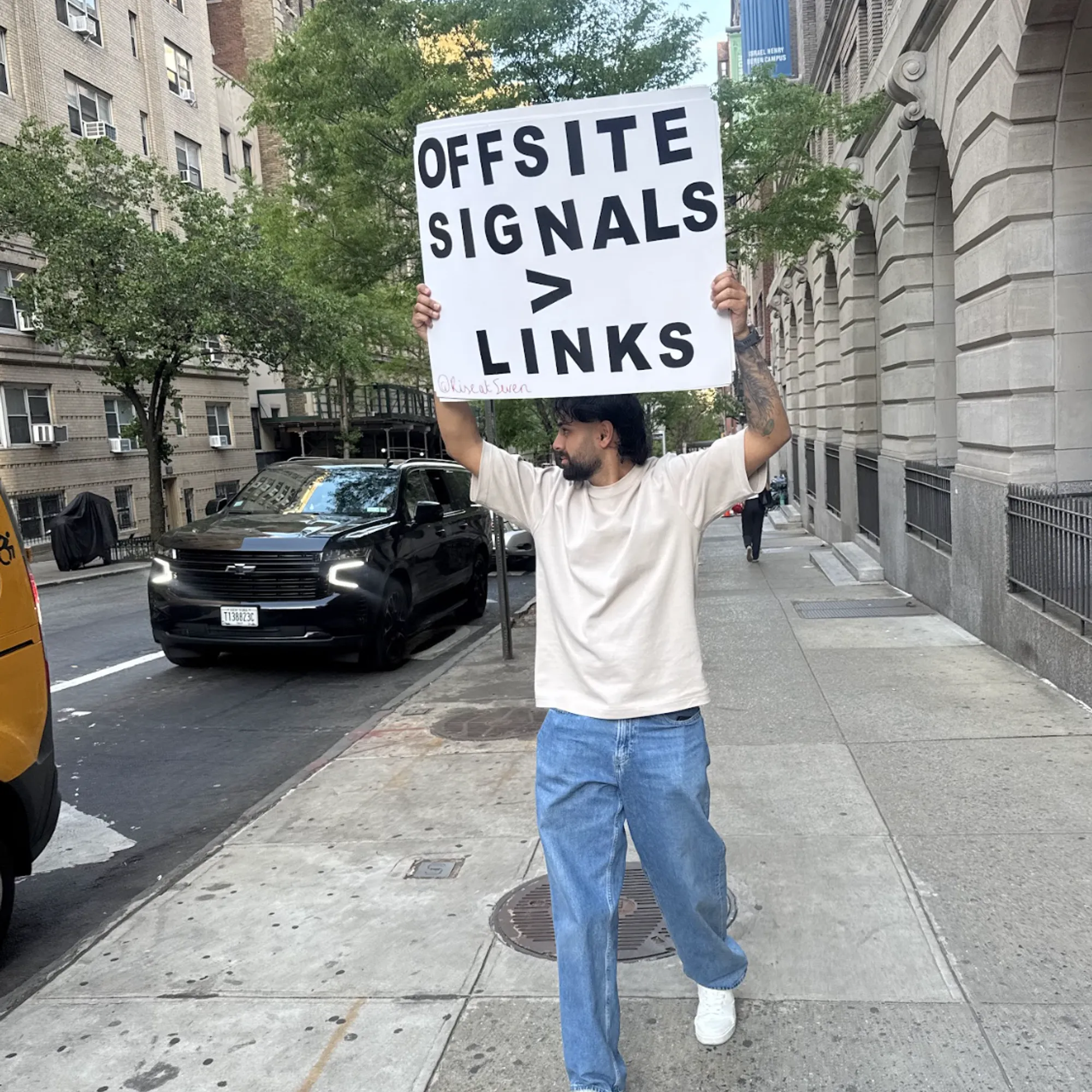
I gave an example at SEO Week NYC 2026 where a brand team for an eSIM brand described themselves as a "global leading tech start up"
But when I asked ... so what is it you do?' and they said "Oh, we sell ESims".
My eyes rolled.
Ok say that then! Because Google, LLM's and people won't have a fucking clue.
Clarity and consistency is key.
And here's an uncomfortable truth for everyone selling "AI visibility tracking" right now.
Being cited is not the same as being recommended. An LLM can reference your blog post and still tell the user to buy from your competitor. Run the same prompt five times, you'll get five different source lists. Chasing citation volume without asking what the machine actually concludes about you is chasing impressions all over again.
Side thought:
Why Ryanair should be something to look to:
You might HATE Ryanair for positioning themselves as the cheap flight company. but do you know who loves them AI. they're consistent. they don't blag your head about being high quality. They're honest " you probably won't get a window at your seat". If marketers want to be inspired, be inspired by THAT.
We built our Category Leaderboard because share of voice in AI answers only matters when you connect it to demand — search demand, brand demand, and whether you're the default answer in your category. That's the metric that moves revenue. Not "we got cited 40 times this month."
The goal was never visibility. The goal is being the brand the machine recommends when nobody types your name.
What I'd actually do:
If I were a brand-side marketer right now, I'd stop asking my agency about GEO and start asking these questions:
Do people search for my brand by name, and is that growing? Because branded demand is the strongest signal there is - to Google, to LLMs, to humans.
When I'm not in the room - or the prompt - what does the internet say about me? Is it consistent? Is it recent? Is it TRUE? Run an audit of offsite and correlate it to onsite. Get your agency to build an entity map - or we will do it for you...
Am I earning coverage, conversation, and community - or am I just publishing content and hoping a crawler is kind to me?
Are we optimising our content (Everywhere) for a pain point/problem we solve, or just the product. People go to AI not to search for products but pain points now - they're sharing their dry skin problems, or hair thinning. You'll get recommended if you and others are talking about your product as a problem solver
And is my product actually good enough to survive a machine that compares everything, instantly, for free? Because the era of out-marketing a mediocre product is ending. Scrutiny used to be expensive. Now it's a prompt.
SEO isn't dead. But SEO alone was never the job.
I built Rise at Seven because I fucking knew this was coming. Even when I was 21 years old, I thought SURELY we can't spend our careers manipulating this shit. Keyword stuffing and building links hoping Google will get blagged and believe we are the best lawyers or best insurers.
Crawlability, indexation, retrieval- that's still the basics. If the machines can't access your content, you don't exist in the evidence set at all. Anyone telling you to abandon SEO for GEO doesn't understand how these systems actually work.
But the job was never really "rank the website." The job was always: make the market want you, know you, and trust you. Search was just where that showed up.
AI hasn't changed the job. It's exposed everyone in SEO who was only doing a fraction of it.
So no - I won't be rebranding as a GEO agency. The acronym isn't the strategy. Being the most talked about, most trusted, most in-demand brand in your category is the strategy.
Oh, and lastly, is your website still relevant - another question everyone keeps asking?
YES, it's the first place AI goes and the last place people go (to buy). Without it, you'd disappear.
Stop taking things literally. Be smart.
We've got a lot of smart people doing stupid things.
Written By
Carrie Rose
Founder
Tue 28 Jul
CEO & Founder of Rise at Seven, and my job is to be out in the market and see which way the wind is blowing in the next 1, 2, 5 or 10 years time and bring that home to my team and clients. I lead the vision of the agency across the UK & US.