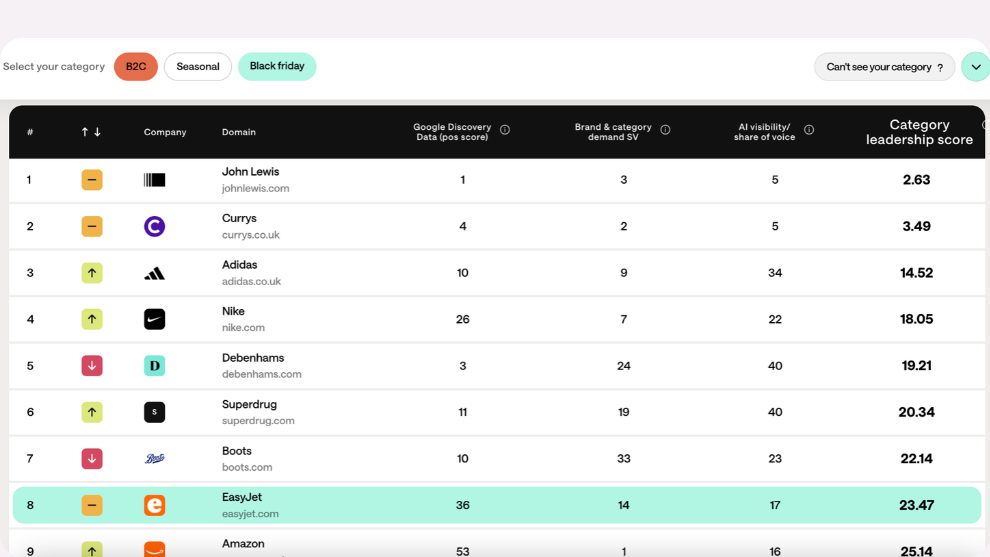
Open Rise at Seven’s Black Friday Category Leaderboard and the top of the table is who you’d expect. John Lewis. Currys. Adidas and Nike. Superdrug and Boots.
Then, in eighth place, an airline??
[The leaderboard currently runs on last year’s Black Friday keyword set. We’re expanding it to cover new products and more deal-led searches, so the positions may move.]
Nobody unboxes an easyJet flight.
Yet when I checked the live leaderboard on the 18th November, easyJet sat above Amazon, B&Q and PlayStation in a category built on TVs, trainers and beauty. That raises a question every marketing leader should be asking right now: how does a brand become relevant to a moment that’s much bigger than its own category?
Why an airline belongs on this list
The leaderboard tracks UK Black Friday demand through .15k terms with 7.7m searches across November. Most are what you’d expect to see like TVs, air fryers, trainers, gaming consoles, retailer names. Thirty-three are about trips flights, holidays, all-inclusive breaks, ski holidays, city breaks, hotels, cruises and rail.
So easyJet isn’t gatecrashing that. Travel is a small but real part of the demand we measure, and an airline obviously isn’t competing for laptop searches. A broad leaderboard puts brands serving different parts of the same occasion side by side.
The interesting part is how easyJet earns its score and the part you should care about
More wanted than found
Every brand on the leaderboard is scored on three signals
how visible it is in Google
How much demand there is for the brand
How often AI search recommends it.
Lower is better. The idea behind it is simple to lead a category, you have to be found and wanted. (If you want to see a breakdown of how this works in more detail, if you go to the leaderboard page, there's a video from our founder Carrie explaining exactly how this works.)
easyJet’s weakest signal is Google discovery, at 36. Its brand demand score is 14 and its AI recommendation score is 17. On AI recommendation, that puts it ahead of Nike (22), Boots (23) and Adidas (34).
So in a category where travel is a sliver of the searches, easyJet’s strength sits in the two signals closest to association... people looking for the brand, and AI search recommending it.
This might sound familiar to you. Every time I book a trip now, I use AI as part of working out where to go.
When I checked the flights page ahead of this year’s event, it was already doing a job. It gave visitors a clear place to land, with relevant flight sections, links through to package holidays and answers to common questions.
easyJet has a dedicated destination for Black Friday flight demand before the main flight sale begins.
It isn’t a one-off. easyJet’s own announcements document Black Friday campaigns in 2024 and 2025, followed this year by an early holidays sale announced on 29 October 2026.
The leaderboard can’t tell us how much of easyJet’s position that work explains, but a brand that builds a ‘destination’ ;) for the moment and comes back to it every year is exactly the pattern I’d want any marketing team to study. It makes sense, right? Reinforcing your association to a topic.
Change the question in the planning meeting
Most Black Friday planning starts with “What are we doing for Black Friday?”
It’s a reasonable question asked too late. I’d start with a different one: what have we already done to make our brand a relevant choice when the demand arrives?
That rewrites the meeting (sorry). You need to know what people want from your category during the occasion, where they should land, what will help them choose and how they’ll find your offer in the first place.
For a travel brand, that might mean helping someone tell a flight deal from a package holiday, or work out when the offers actually go live. For a beauty brand, it might mean helping someone compare devices or choose a gift.
None of that comes together the week before. Getting it live early gives you time to make it genuinely useful, connect it to the rest of your site and fix what isn’t working before the busiest days. (So get started for next year!)
Black Friday is just the easiest one to see
The same logic applies to any association you want to build.
If you want to be considered for marathon training, what role do you play during the months of preparation? If you want to be chosen for small-space living, do your products, advice and campaigns consistently help, or does it appear in one seasonal edit? If you want to be the place people go for gifts, what helps them choose before the last delivery date turns browsing into panic?
Association needs substance. It has to show up in what you sell, what you publish, how you talk about it and what people find when they arrive.
What to take into your next black Friday planning meeting
Pick the occasions where your brand has a credible role. Look at the demand inside them, including the searches that never mention the event by name. Build useful destinations early, then make sure your campaigns lead people into them.
Then measure the right things. Google visibility alone would have told you easyJet was a middling Black Friday player. Demand and AI recommendation tell a more interesting story. That’s the work we care about at Rise, using search insight to show a brand which moments it has a genuine right to win, and which ones it’s only hoping to borrow.
You can buy visibility in the week of the peak. Being wanted has to be in place before it starts.
What do you want your brand to be known for when demand peaks?
At Rise at Seven, we help brands identify the opportunities that matter and build the visibility to compete.
Ray Saddiq is a leading voice in the world of Marketing SEO and social media known for connecting the dots between how people search and how they scroll. As Head of Marketing at Rise at Seven, he’s pioneered approaches that treat platforms like TikTok, Pinterest, and Instagram not just as content channels but as search engines.