How to see (and improve) your AI Overview visibility in Google Search Console
Share
Google's new generative AI performance reports show how often you appear in AI Overviews and AI Mode. Here's what they reveal, what they miss, and how brands actually earn citations.
Most weeks at the minute, someone senior asks me a version of the same question...
A CEO has read that AI is killing search, or a board member used ChatGPT instead of Google for the first time and got a bit of a fright, and now the marketing team has been asked how visible the brand actually is in AI. Usually there's budget attached. The trouble was that, until now, nobody could answer it with data they owned. They were inferring it and hoping.
That changed this week.
🚨 Google Just rolled out AI performance data in Search Console - BIG CHANGE 👇
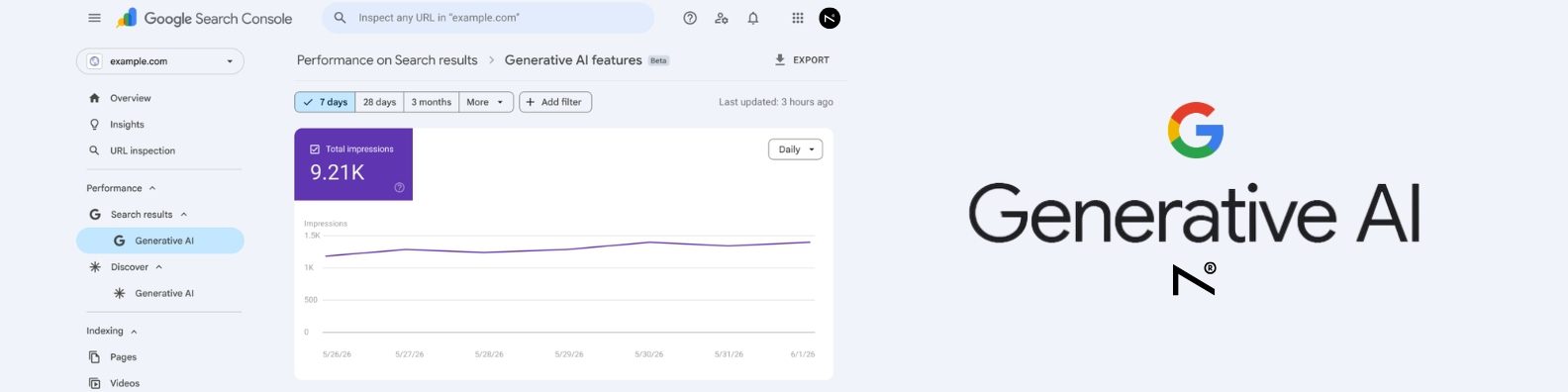
Google has started rolling out generative AI performance reports in Search Console, which means for the FIRST TIME you can see what share of your impressions are coming from AI features like AI Overviews and AI Mode, using Google's own data rather than a third-party estimate. It's a real step forward.
But measuring a problem and fixing it are two very different jobs, and the gap between them is where I think most brands are about to get stuck.
Why your board is right to care
It's tempting to file AI search under "worry about it later". The numbers make that hard to defend.
Ahrefs looked at 300,000 keywords and found that when an AI Overview appears, the top-ranking page loses 58% of its clicks, up from around 34.5% only eight months earlier. BrightEdge's year of tracking shows you why. The average AI Overview is now more than 1,200 pixels tall, so on a normal screen the actual search results sit completely below the fold. You're not losing the click because you slipped a ranking. You're losing it because nobody scrolls that far.
And this isn't a niche corner of search. By February, BrightEdge had AI Overviews showing on roughly 48% of queries, and that was before Google's May overhaul pushed AI even deeper into the experience. How hard it hits you depends a lot on your category, mind.
Ahrefs' analysis of 146 million searches found them on well over half of question-style searches and 44% of health queries, against just 3% in shopping. Add a billion people now using AI Mode within a year of launch, and you can see why a board reading about this gets twitchy. They're not panicking over nothing.
What the report actually changes
The value is in the separation. Until now, if your page turned up inside an AI Overview or AI Mode, that activity was folded into your general Search Console numbers and you couldn't pull it apart. You'd see clicks softening but couldn't cleanly say AI was the reason. Now you get a dedicated view, broken down by the pages appearing, by country and by device, with a version for Discover too. It won't tell you everything, but it ends the guesswork about whether AI is where your visibility is going.
Two big caveats. It's rolling out to a subset of properties first, so your team may not have it yet. And it's impressions only. It tells you how often you appeared, not who clicked or what it was worth. It's also Google only, so it sees nothing of ChatGPT, Perplexity or Gemini. Useful, but a starting line rather than a finish line.
Google isn't even first to this. Microsoft added an AI Performance report to Bing Webmaster Tools back in February, tracking Copilot citations, and arguably went a step further by showing which pages actually get cited, not just impressions. So treat this as the industry's direction of travel, not a Google one-off.
And it doesn't replace the third-party tools. Google only ever sees Google, so you still need the likes of Ahrefs and BrightEdge for the other platforms and the competitor picture. What's changed is that you've now got the platform's own numbers sitting alongside the estimates, not instead of them.
Measuring it is the easy bit
This is the part that actually matters, though. A report telling you you're barely showing up in AI answers isn't, on its own, worth that much. It makes the problem visible, which matters, but the question your board asks next is the harder one. Fine. So how do we improve it?
And there's a catch that trips a lot of people up. Ranking well doesn't necessarily get you in. Ahrefs found only about 38% of the pages cited in AI Overviews also rank in the top 10 for that query, and that's down from roughly 76% a year earlier. BrightEdge, measuring it a bit differently, puts the page-one overlap lower still, nearer 17%. Take your pick of the method, the conclusion's the same: most of what gets cited isn't coming from the pages sitting top of the rankings. You can rank number one and still be missing from the summary the user actually reads.
So what gets you cited, if not ranking?
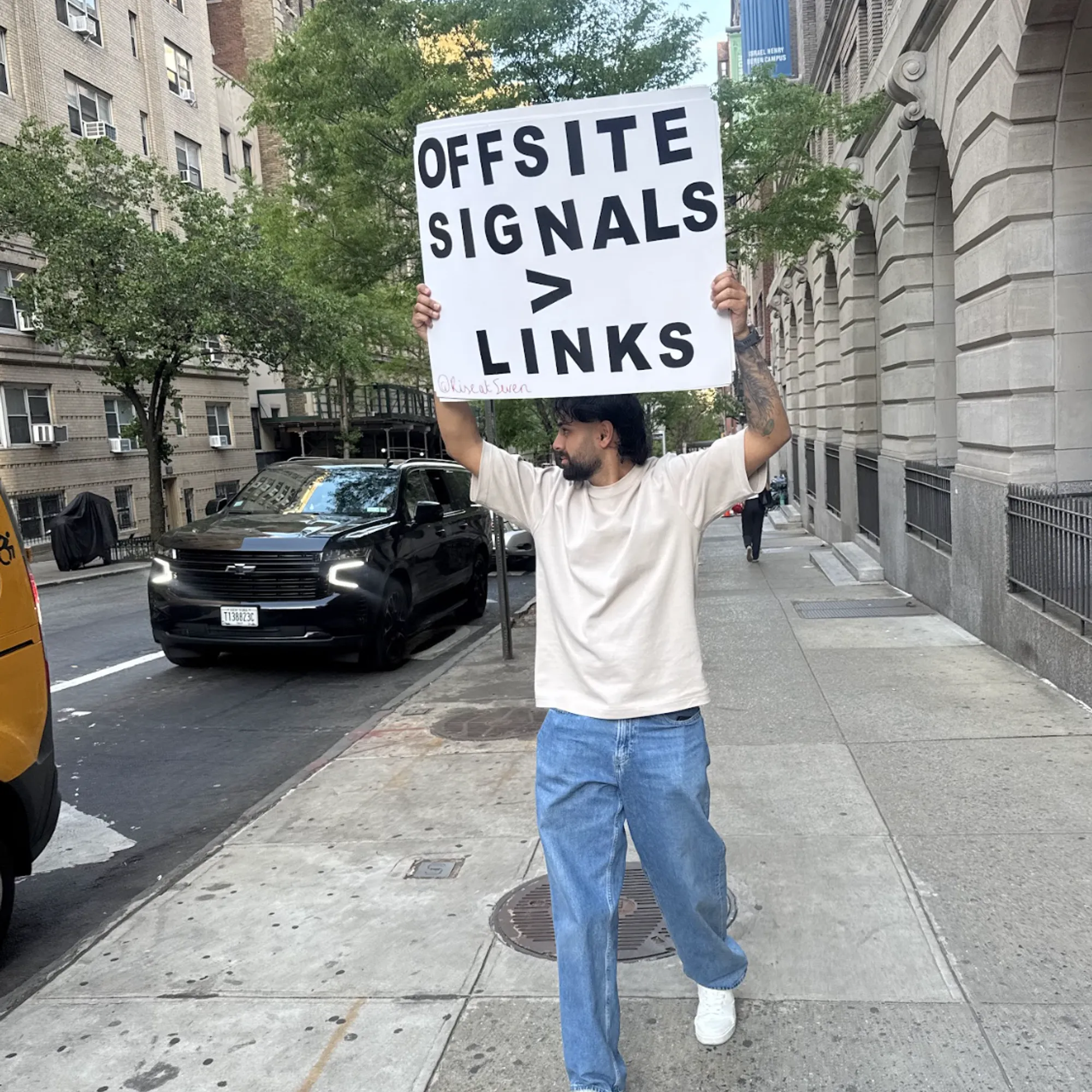
Two things mainly. The first is how Google finds sources. It runs a query fan-out, splitting one search into dozens of related sub-queries and pulling sources from across all of them, so a page can be cited for a question it doesn't even rank for. The second, and the bigger one for brands, happens off your own site. Ahrefs studied 75,000 brands and found the factor most strongly linked to AI visibility wasn't rankings or backlinks. It was mentions: how often a brand gets talked about across the web, in articles, guides, forums and video. Branded links, the kind earned through coverage and PR, came next, especially in AI Mode.
What barely moved the needle was raw backlink counts and sheer volume of pages. So this isn't a link-buying race or a content-farm game. It's whether the wider web, and the models trained on it, treat you as a name worth mentioning. A fair caveat: that's correlation, not proof, and some of it just reflects brands that are already well known. But it points the same way every time, and it's really a digital PR and brand problem wearing a search costume.
Our view at Rise at Seven is that the craft carries over from SEO, but the target has moved. The old job was to rank. The new one is to get cited, and those aren't the same thing any more. You still need the foundations that always mattered: a clean technical base, genuinely useful content built around what your audience is asking, and real authority off your own site through digital PR, reviews and coverage. What's changed is what you're building it all towards. The foundations transfer. The assumption that nothing much has changed is the trap.
And it does move when you work at it. We've taken a travel client from barely present to appearing in roughly 750 AI Overviews, up nearly 700% in a year, and ahead of much bigger-name competitors on the searches that matter to them. That's not a theory, it's a number we can point to. That took third-party tracking to prove, mind. What Google has just shipped gives every brand a first look at the same kind of visibility in their own data.
The questions to take to your team
When you open the report, or ask why you can't yet, these are the questions worth putting to whoever owns search for you:
Which of our priority queries trigger an AI Overview or AI Mode answer, and are we cited when they do?
Where we rank well but don't appear in the AI answer, do we understand why, and what are we changing about those pages?
How exposed is our specific category, are AI Overviews common for the queries we care about, or fairly rare?
How are we tracking the platforms this report can't see, like ChatGPT, Perplexity and Gemini?
Are we earning the mentions and coverage that AI pulls from, not just chasing links and pages?
If those come back clear and specific, you're in good hands. If they come back as a shrug, that's the gap, and you'd rather find it before the budget goes. One thing to hold them to: benchmark against your own category, not a headline average. Health behaves nothing like retail, and an industry number tells you very little about your own queries.
Should you use the new opt-out?
Worth knowing where this one came from, because it wasn't Google's idea. The opt-out sitting next to these reports was forced by the regulator. The UK's Competition and Markets Authority told Google it had to let publishers remove their content from AI Overviews, AI Mode and the AI answers in Discover, after publishers watched their traffic fall while their work kept turning up in the summaries. The UK is the test market, and Google's been given nine months to roll it out, which is the same reason these reports are landing here first.
Opting out won't touch your normal search rankings, which is the reassuring part. But I'd still think hard before reaching for it. For most brands it's the wrong lever. Opting out of the AI answer doesn't change how people now search; they'll still ask the question in AI Mode, you'll just have decided not to be in the response when they do. The brands it genuinely suits are the publishers who fought for it, whose whole model lives on the click and who'd rather be absent than quoted and skipped. For everyone else, the visibility is the asset, and the report sitting next to the toggle is how you finally measure it.
Where this leaves you
None of this is the finished picture. It's a subset rollout, it's impressions not attribution, it only covers Google, and we'll all want a few months of data before the patterns are worth trusting. But the ground has shifted. A year ago, "how visible are we in AI?" was a question marketing teams couldn't really answer with their own data. Now there's a real starting point, and the teams who treat it as the beginning of the work, not the end, will have a far better story for their board. This is most of what we do at Rise day to day, so if your team hits the wall on the "how do we actually improve it" part, that's the conversation we like having.
The measuring just got easier. The improving is still the job, and it's the part worth getting properly stuck into.