Search is no longer just where demand is captured.
Share
It's where demand is created.
When I ask CMOs how central their SEO team is to their planning and strategy the answers I get range from “not very” to “SEO doesn’t sit in the marketing team”, to “we don't have an SEO team”. If I ask them the same question regarding their Search team, I’m often met with confusion around what that actually means. Is it PPC? Is it SEO? or is it the insight engine behind the entire marketing ecosystem? Well, change is coming. Consumer behaviour is moving the goalposts around what drives value and the leaders are paying attention and already moving with them.
I spent years running Digital Marketing for a billion-dollar retailer and was challenged regularly to make my budgets go further. The fact is, some of the most prominent brands in the world are increasingly overreliant on paid to drive growth. What’s interesting about that is how those same brands are undermining the most potent audience insight to help deliver it.
In this shift of agentic search and AI marketing, lets admit SEO has an identity crisis but a sense of real importance all at the same time.
At Rise at Seven, the last 6 weeks have been wild! Multiple large-scale challenger and enterprise brands have sent us RFPs, we've had at least one a day - where the brief isn't “we want to hire an seo agency” but we want to be discoverable across every touchpoint and need a strategy to ties that together.
So, let me explain why they are coming to Rise to help create that value.
We're creating category leaders of our brands on every searchable platform.
And EVERY searchable platform is the key. Why?
The world of marketing has changed significantly as consumers are more actively involved and assertive in the process of solving their problems and as a result, search is now the fundamental action at every stage of the customer journey, evident in Rise at Seven’s 2026 study of how people search.
The study found that consumers are jumping between 3.6 platforms on average, having 97 interactions and evaluating 2-8 brands now as a result. Carrie Rose, Founder of Rise at Seven (and my boss) says, “The value of being found vs being known has become significantly higher.”
That's not to say that brand marketing has weakened, not at all. Search-first doesn't mean allowing search volumes to dictate a marketing strategy, and brand will always be the driver of demand generation. In fact, search volume as a metric becomes less telling as people move to asking questions and sending prompts.
What a search-first philosophy does is provide a richer source of insight of our audience's problems, questions and ambitions for brands to connect to. Ad agencies spend hundreds of thousands figuring out what customers want and their pain points. But the data is free, in a search bar. People are telling us EXACTLY what they want every second of the day and they're even layering it with the why now. That is what is making “SEO” or “Search” so influential in planning & strategy.
At Rise, Demand and Discovery are the two objectives we place central to everything we do. We believe they are the levers for growth that when achieved as one, are greater than the sum of their parts. We also believe that both can be achieved through a search-first philosophy.
Emerging platforms and consumer behaviour have materially shifted each channel's role in communication. People are not just using social platforms to have content thrust into their hand, they're actively searching for inspiration and answers.
The Rise at Seven 2026 study shows social channels collectively make up 60% of discovery in analysed journeys. Community platforms like Reddit are growing outside of the US and becoming more dominant than Wikipedia for information.
This Peec.ai report is one of many sources that show the platform as the leading source for citations and search results, despite the recent declines in AI search. Creators, experts, and the media continue to be a leading source of authority for brands and are increasingly dominating search results; a recent report by Muck Rack cites earned media as driving 84% of AI citations. All of this is impacting how LLMs like ChatGPT and Google's AI Overviews are answering questions and serving users.
The key to maximising Discovery and generating demand- the real unfair advantage- is joining up the dots between all of these content sources, all of these channels, these teams, and often siloed departments.
Let's be honest, most social media managers probably don't know the SEO person's name. And it's not just social. PR, comms, brand.
Integrated marketing and integrated content planning is something that marketers have had in their OKRs for almost a decade, and whilst some brands might have a strong go-to-market process for the next big launch, brands need to go further than relaying the same message across all channels.
Marketing leaders are now being forced to make this a reality.
We’ve worked with over 300 brands since the birth of the agency and I will tell you, there are few brands truly joining those dots between SEO and search as insights, with their messages in PR, social, and paid media. And as a result, often Rise at Seven is hired to do that job. What I believe is that all of these channels are now and should be, intrinsically linked with a brand’s search strategy, and in that, a brand’s marketing strategy.
I've stood on stages and told young SEOs that their role is now central to marketing, not just e-commerce, not just the website, but the entire marketing ecosystem. Search should be viewed as so much more than best practice for demand capture.
Let's take a brand's personas. Who they are, what they're into, how they absorb media, even. All very important in defining your messaging framework. But what are they actually asking ChatGPT late at night? What inspiration are they looking for on TikTok? What are they trying to learn or solve on YouTube? This is how you connect the dots between who your audience are and how you connect with them. Search becomes the bridge between insight and action.
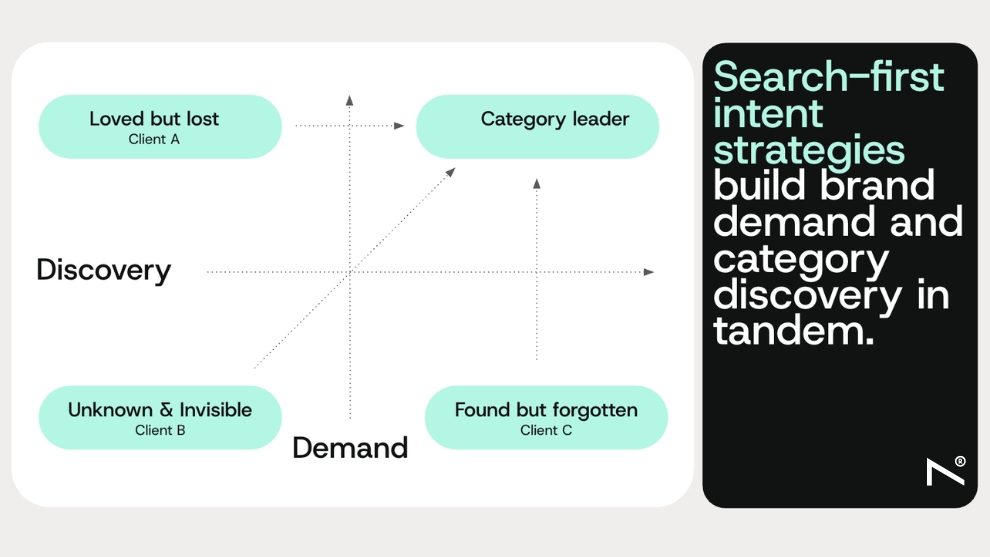
To be a category leader, brands need to both generate demand and maximise discovery.
A brand with all the demand in the world who isn't discoverable will be loved, but they'll be lost. A brand that is easy to discover but not generating demand will be found, but soon forgotten. Whilst brands with neither are both lost and forgotten, brands with both create compounding growth, and we see that with our clients.
To boil this down to its simplest form, I’ll share an example for a running shoe brand. If aspiring runners search for running trainers, Brooks repeatedly comes up in my answers. Associations for the brand Brooks and running trainers grow. As a result brand and category-associated searches grow. More people begin to review, link to, search for and create content for Brooks running trainers. Authority and presence within the category grows. Brooks becomes easier to discover.
This isn't just theoretical; we see it often. For Rise client Pooky, creator tutorials, PR, and targeted content coincided with +4,496% search demand, #2 ranking (above Amazon), +23% YoY revenue. We have similar examples for Ninja and Interflora.
The fact is the right signals, repeated enough in the right places, build association in both humans and machines. Therein lies some beauty of AI's and LLMs' fast development. Modern discovery engines increasingly find their data from the same sources as people do to form their opinions, be that publishers, creator communities, experts and the brands themselves.
A tangible example of the benefit of both demand and discovery is Rise at Seven’s category Leaderboard. It combines demand and discovery metrics with AI visibility to measure whether a brand is becoming synonymous within their category, rather than looking at those metrics in isolation.
It ALWAYS starts with your audience. Marketing teams should be awash with persona data based on demographics, interests and often behavioural insight too. What media reports and surveys won’t tell you, however, is the deep human truths that audiences type into search bars across the web.
We can have a solid grasp of who our audience is, and what they say they believe, where they spend their time online and what they buy.
Search can tell us what they’re trying to solve, what they’re worried about, what they’re considering, who they're comparing, what they don’t understand and what they really want. This is behavioural data with real intent. Overlaying search data onto target consumers to really uncover the problems they're trying to solve is that extra step to create valuable content. And this goes way beyond Google.
The explosion of LLM, social and community search has added layer upon layer of rich insight to this data source and allows us to uncover the white space for content, way before a person knows it's even a running shoe they need; it’s better fitness, more steps, ideas for the weekend.
Are you seeing the magic yet? Search, after long being seen as a demand capture channel, has the capability to be the entire marketing funnel's insight engine.
The task, as ever, is to ensure our owned content is meeting the needs of our consumers, to inspire, to consider, to convert, and to return. In this increasingly agentic world, saying something on your owned channels isn’t enough. Owned content will generate significantly more value if its claims are backed up in earned and shared, and whilst paid has obvious value (more to come on that in the next article), but trust and authority cannot simply be bought.
Integrated ecosystems. This goes beyond the term integrated Marketing and “let’s say the same thing everywhere”. It’s knowing each distribution channel's distinct role in building demand and generating discoverability with the right signals and associations.
The brands that do this well create a distinct shift in the objective and result of their content, and most significantly at the top of the funnel. Not simply pushing a brand message, but folding that into future customers' wants, needs, problems and ambitions, based in real human truth. Creator content that answers questions and dominates search results vs disconnected aspiration; media publication placing brands in minds before a journey begins, community content that provides value and authenticity, and onsite content that mirrors external validation and inspires consideration.
The subject for most marketing leaders around search right now is: how do I stop organic from declining, and how do I show up in LLMs? The truth is an SEO or AEO team will never succeed whilst working in a silo of a Marketing ecosystem or as a channel for demand capture. It’s not simply about Search or SEO having a bigger seat at the table or even what table it should sit at.
It’s about harnessing behavioural intent that PR, creators, social, onsite, SEO, AEO and Paid can plan from. If search is viewed and structured as the nucleus to earned, owned, shared and paid strategy and planning, the growth in demand and discovery becomes compounding.
The question isn’t really where search sits within a team. It doesn’t sit anywhere. It runs through everything. From the audience insight that fuels a strategy, to the creative idea that generates demand, the creator who posts about it, the journalist who validates it, the blog post that solves the problem and the AI that responds to the question.
Search is no longer just a tactic to be in the response. It can also be the insight that puts brands into the prompt itself.