A million people just pressed "AI slop" while Google built a watermark
Share
The cheapest content you'll ever publish is also the most expensive
Brands keep asking me the same question: if AI can write content in seconds, why are we still paying writers to do it?
It's a fair question, to be honest. ChatGPT, Claude and Gemini can produce thousands of words before a writer has finished their first coffee, and the economics are tempting. If you need 100 category pages, 50 blogs or hundreds of product descriptions, why not hand an AI the brief, press generate and publish the lot?
The answer isn't that AI content is bad. It isn't. Most good content teams use it to some degree now. The problem starts when AI stops assisting the writer and starts replacing them. With slop.
Because we've seen this movie before.
AI content isn't the problem. AI slop is.
Google isn't saying ‘AI touched this page, therefore we're not ranking it’ Its own guidance says automation and AI can be used to create useful content. What Google targets is content produced primarily to manipulate rankings, including scaled content abuse: large amounts of content created with little value for users.
The data backs that up.
In June 2026, Ahrefs looked at a million pages sitting in Google's top 10 results. Of the pages they could test for AI… only 5.3% of the ones ranking in the top three were fully AI written. So let's kill the myth now. AI content can rank in Google and be fine.
The interesting bit that I see is what happens when you lean on AI harder.
Look at the pages ranking first. More than half of them had barely any AI in them. Fewer than one in ten were mostly AI. And the pages using little or no AI got two to three times as many views from Google as the pages that were stuffed with it.
Ahrefs is careful about what that proves, and so am I. Just because two things happen together doesn't mean one caused the other. The AI checkers are making a best guess, not reading a label. And plenty of heavily AI-written pages rank perfectly well.
But the boring explanation is usually the right one. The more you lean on AI, the more the quality slips.
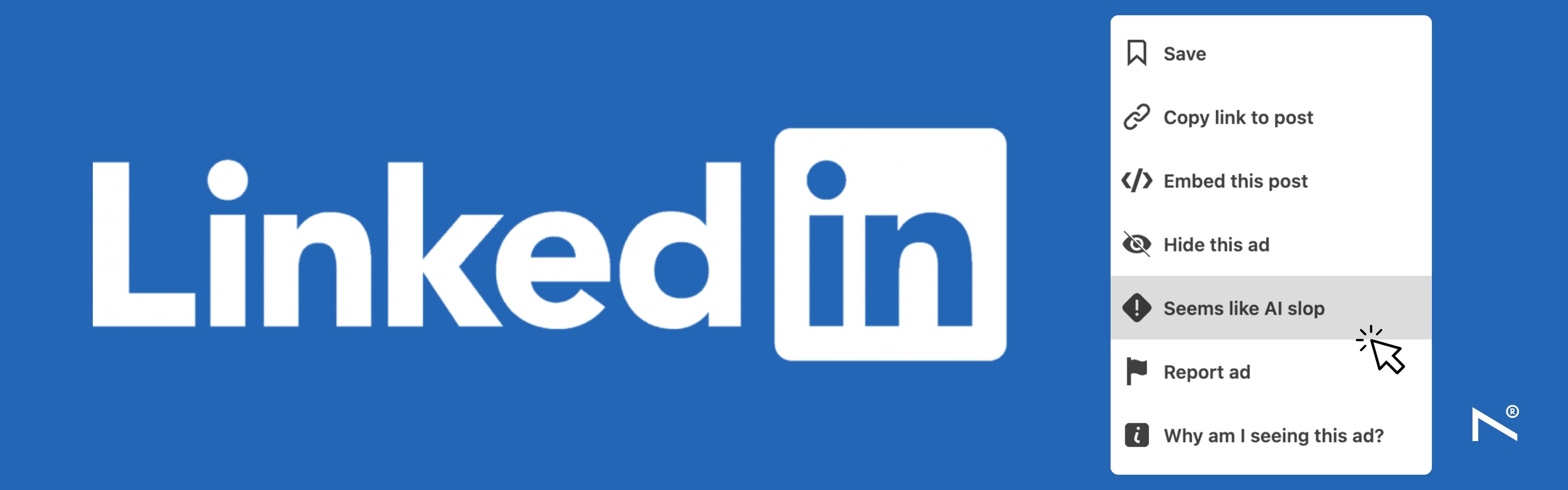
In July 2026, LinkedIn added a "Seems like AI slop" feedback option. More than a million people used it within weeks. LinkedIn's Chief Product Officer says suspected slop now gets around 40% fewer views after changes to its detection and feedback systems.
Look how fast we got here. A few years ago, AI-generated content was a novelty. Then everyone got the same models. Then everyone's feed started sounding like everyone else's feed. Now a major platform hands its users a button to tell the algorithm this one feels fake.
I'll be real, that should matter to us as marketers. Not because using AI makes something bad, but because platforms have every incentive to separate original work from cheap, mass produced filler. When everyone can generate, generating more stops being an advantage.
The advantage moves to the things the model doesn't have. Your experience. Your customers. Your data. Your opinion.
And then there's watermarking
Now, you've probably seen everyone speaking about this recently. Everyone has a different opinion on it, there’s even conspiracy theories.
Now, Google DeepMind built SynthID to watermark AI generated content. Not a ‘Made with AI’ label stuck under an image. An imperceptible watermark sitting inside the text itself. I honestly find the science behind this really cool, and being a not very technical person trying to understand it has really changed my perspective of how these tools work.
For text, it works during generation by altering the probability distribution the model uses to select tokens. Google says this doesn't noticeably affect the output, but the statistical pattern it leaves behind can be read afterwards to work out whether the text was watermarked. Google has confirmed it applies this to text generated by the Gemini app and web experience.
Search doesn't use SynthID as a ranking signal. There's no evidence it does, and I'm not going to pretend otherwise…
But ask the question anyway. If the company that runs the world's biggest search engine has built a tool capable of identifying AI-generated text, how comfortable are you building your brand's long-term content strategy on untouched AI copy at scale?
Google doesn't need an AI penalty for that to be a bad bet. Its incentives are already public: less low quality, unoriginal content, and more content that actually satisfies people. Google said its 2024 ranking and spam changes cut low-quality, unoriginal content in Search by 45%.
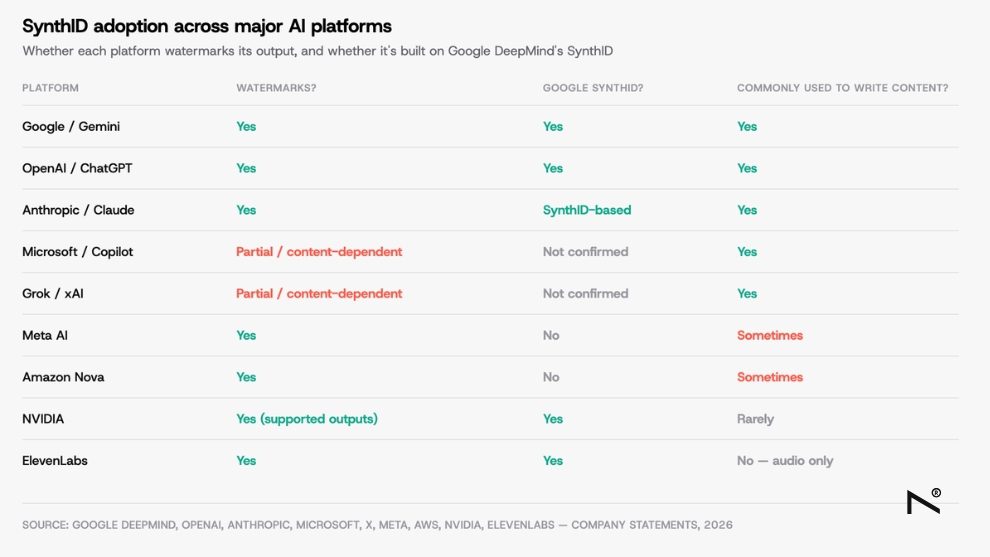
I've had a bit of a look into which models are using this and how exactly it's being used, and I've included below a table that will help you get an understanding of where this is being used.
BTW We've seen this cycle before
Anyone who's worked in SEO long enough will recognise the shape of this.
Before generative AI, we had article spinners. Take an existing article, swap the words for synonyms, generate a hundred ‘unique’ versions, publish them across sites. Technically not duplicates. For a while, some of them ranked.
Then Google's systems got better… Because this affects how the audience, the consumer, is taking in this content, if people don't want to read this, they improve their systems so the content standards are higher.
The cycle repeats. A cheap new way of producing content appears, marketers work out it scales, everyone piles in, the results fill up with low value versions of the same thing, Google improves, and the advantage evaporates.
AI is orders of magnitude more sophisticated than an old school spinner. I'm not comparing the technologies. I'm comparing the behaviour..
The dangerous part was never generating a paragraph with ChatGPT. It's taking the cost of content to almost zero and concluding that the correct strategy is therefore to create an almost infinite amount of it.
Google's scaled content abuse policy is almost tailor made for that distinction. It applies whether the content came from automation, humans, or a mix of both. The tool was never the issue. Publishing at scale for rankings rather than readers is.
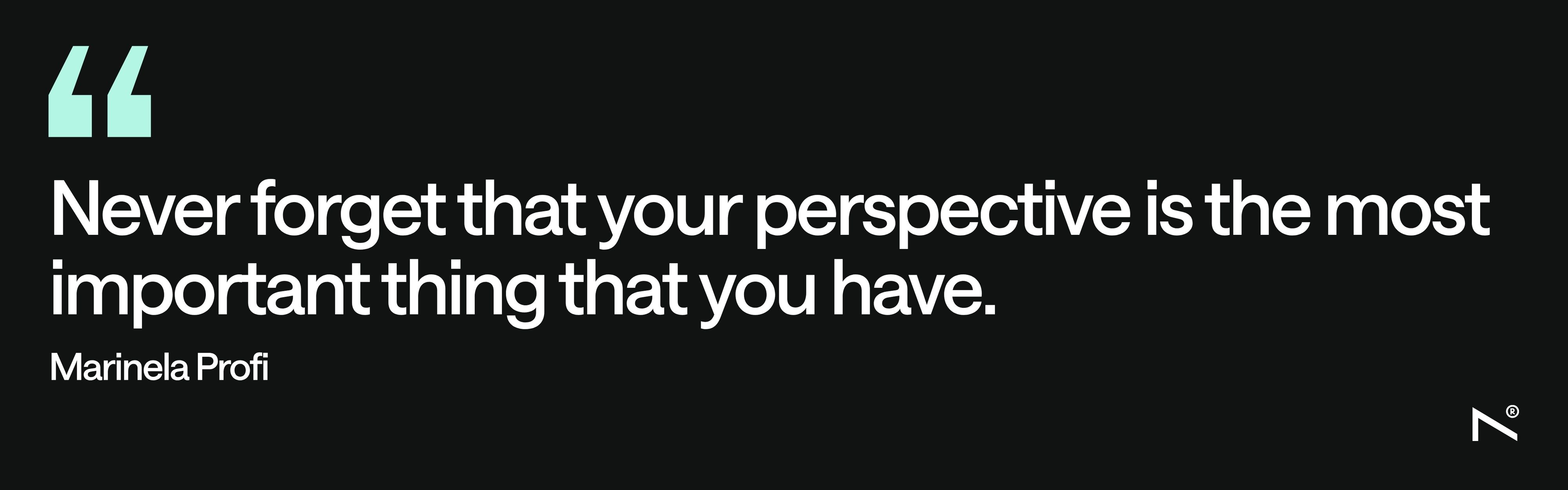
Marinela Profi said something that stuck with me:
AI content isn't inherently bad, but most of what's being generated is slop at scale, and slop at scale means everyone ends up sounding the same. Use AI so the mechanics of writing stop being the bottleneck. Don't use it until your perspective disappears with them. Because the question you're left with is a simple one: if your brand reads like the other thousand brands in your category, who's buying from you? Who's learning from you? Who's being entertained by you? You can train a model on your tone of voice, and you probably should, but that's a step in the process, not the strategy. The strategy is having a perspective worth training it on in the first place.
So why pay a writer?
Because you were never paying for the ability to type 1,500 words.
A good writer decides what deserves to be said. They interview the experts. They challenge the brief. They notice when a sentence sounds wrong. They know the customer, they read the culture, they find the statistic everyone else walked past, and they can tell when the SERP is handing you the wrong answer.
They understand your customer, and they understand culture. I heard something recently. People know when to stop. I can't remember who said this quote but the thing that AI doesn't understand is.. when does a piece of art finish? That's in taste, and it's something that's very hard to learn, especially with written content.
AI is brilliant at handling information that already exists: researching, summarising, structuring, drafting, reorganising. Use it for all of that.
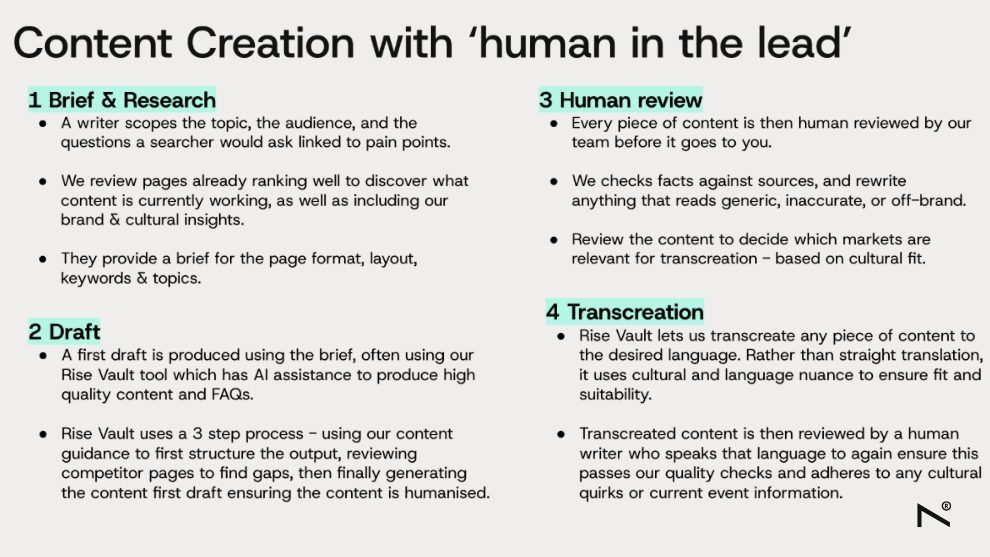
Our approach: human in the lead
We don't have an anti AI content policy at Rise at Seven. That would be ridiculous.
We have a human in the lead policy.
Our writers start with the audience, the search behaviour and the questions people are actually asking. We analyse what already ranks, then go looking for what's missing: brand expertise, first-hand experience, cultural insight, proprietary data, the perspectives a competitor can't scrape off the same SERP.
AI helps scaffold that. Research, summaries, structure, first drafts. Our own Rise Vault technology uses AI assistance as part of the process.
AI just doesn't lead the creativity, writing style or get the final say.
A human reviews the piece, checks the claims against the sources, strips out the generic language, adds the expertise, argues with the assumptions and rewrites anything that doesn't sound like the brand. When content needs to work in another market, we don't hit translate. We transcreate around the cultural and linguistic nuance, then have someone who understands that market read it.
None of this is about making content look human enough to fool a detector. That's the wrong objective entirely.
It's about handing the machine the parts machines are brilliant at, so the humans get more time on the parts that actually create an advantage.
AI should make your writers better, not redundant
It's scary because an enormous amount of AI-generated content is coming over the next few years.
That makes me more bullish on great writers, not less.
When producing a thousand mediocre articles costs almost nothing, one more mediocre article is worth almost nothing. Original research gets more valuable. Your perspective is key. First-hand experience gets more valuable. So does knowing something nobody else knows, and having a point of view worth publishing.
That's ultimately why we still use writers and you should too,
AI gives everybody the ability to create content. Humans give people a reason to care about yours.
Written By
Ray Saddiq
Global Head of Marketing
Tue 01 Sept
Ray Saddiq is a leading voice in the world of Marketing SEO and social media known for connecting the dots between how people search and how they scroll. As Head of Marketing at Rise at Seven, he’s pioneered approaches that treat platforms like TikTok, Pinterest, and Instagram not just as content channels but as search engines.