


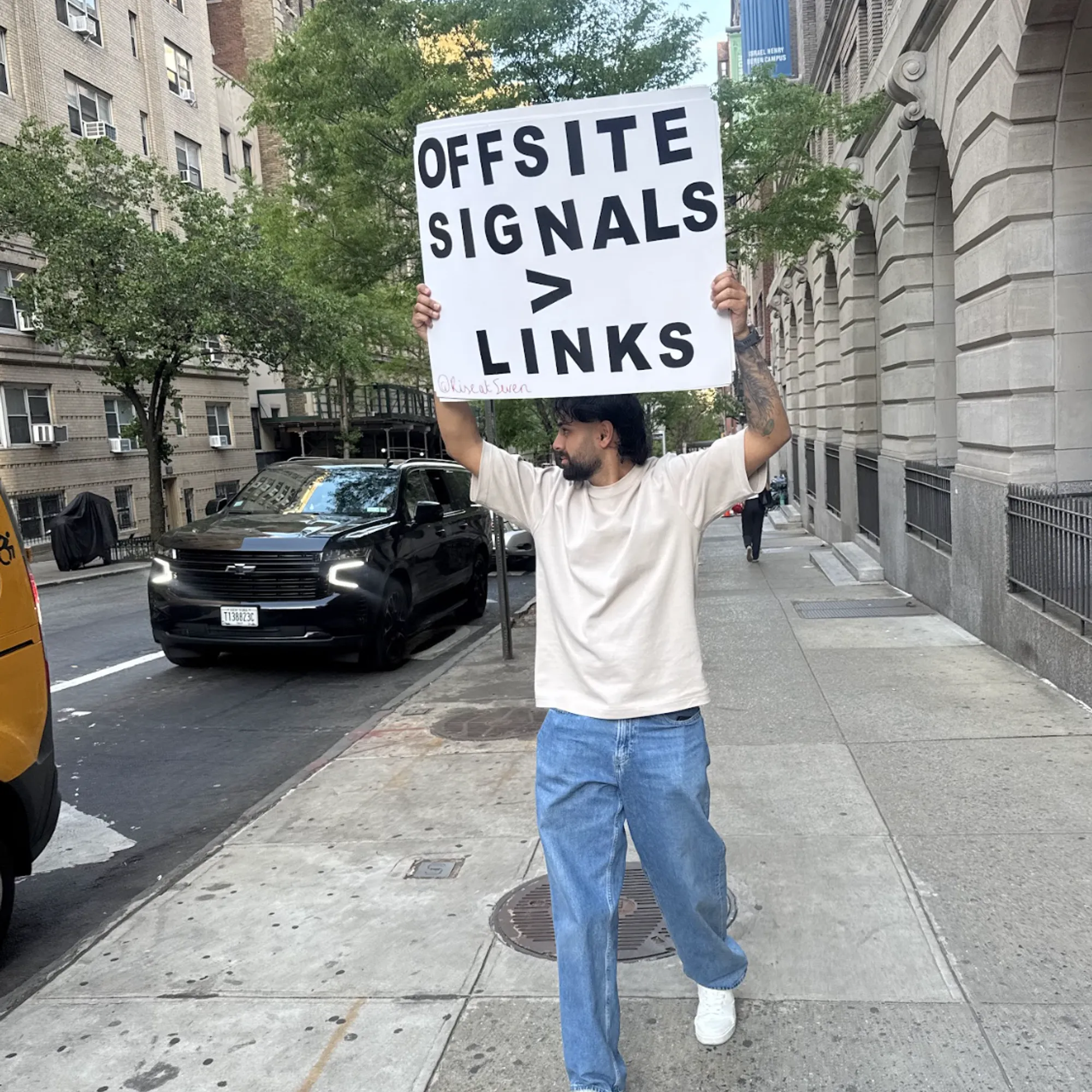






Your Content Is Pretty Useless - And Google Is Telling You This

We are living in a USEFULLNESS pandemic!
An internet world which is being filled with millions of content every single day and less than 10% of it being of any use to humans.
And the question we all need to seriously ask ourselves…
If it's useless to humans, does that mean it's useless to algorithms?
We think so.
Algorithms are getting smarter and smarter. And we're not just talking Google here, we're talking Tiktok, YouTube, LLMs and Linkedin.
Did you know that 91% of content on the web receives zero organic traffic?
Source: Ahrefs
Not low traffic.
None at all.
Why?
Because they’re not helpful enough to deserve visibility. It’s just not useful enough to matter.
It gets published. It fills a content calendar. And then it disappears - unlinked, unsaved, unshared, unread and forgotten.
I see this constantly:
Common issues we see brands do with their content:
1. Enterprise brands spending millions producing hundreds of articles to “fill visibility gaps”, with only a tiny percentage ever earning clicks
2. Content teams publishing five articles a week simply “to fill the blog”
3. Some of the best B2B thinking locked behind paywalls and gated PDFs - completely invisible to search engines and social discovery
We are flooding the web with content. This isn’t a creation gap. It’s a usefulness gap.
And Google - alongside platforms like TikTok and LinkedIn - has been telling us this for years.
Here's some statistics to prove why:
Useless content statistics:
- When it comes to onsite content, Ahrefs found that 91% of pages receive no organic search traffic, and that's strongly linked to low backlink acquisition
- Only 20% of readers finish an article (according to bdow)
- Average visitor reads ~25% of a page (meaning less than a quarter of a piece of content is actually useful to a reader)
- Buzzsumo revealed 50% of content on social receives fewer than 8 social shares
- And they also found that ~70% of content earns zero backlinks
- Buzzsumo's in depth research found that recently - the median social shares per article declined from 8 to 4 shares as content volume increased
- There's not enough original research/unique stats out there. Content with original research or unique insights earns significantly more shares and links
So what should we KPI'ng ourselves on to create more useful content?
The 5 metrics that tell you whether your content is useful
In a world where impressions and followers are overrated, here's what I think you should care about.
If I were a Marketing Director in a B2B business, these are the five metrics I’d put most of my energy into (outside of revenue of course) - because they reflect how useful our content is to our customers or potential customers we produce every month.
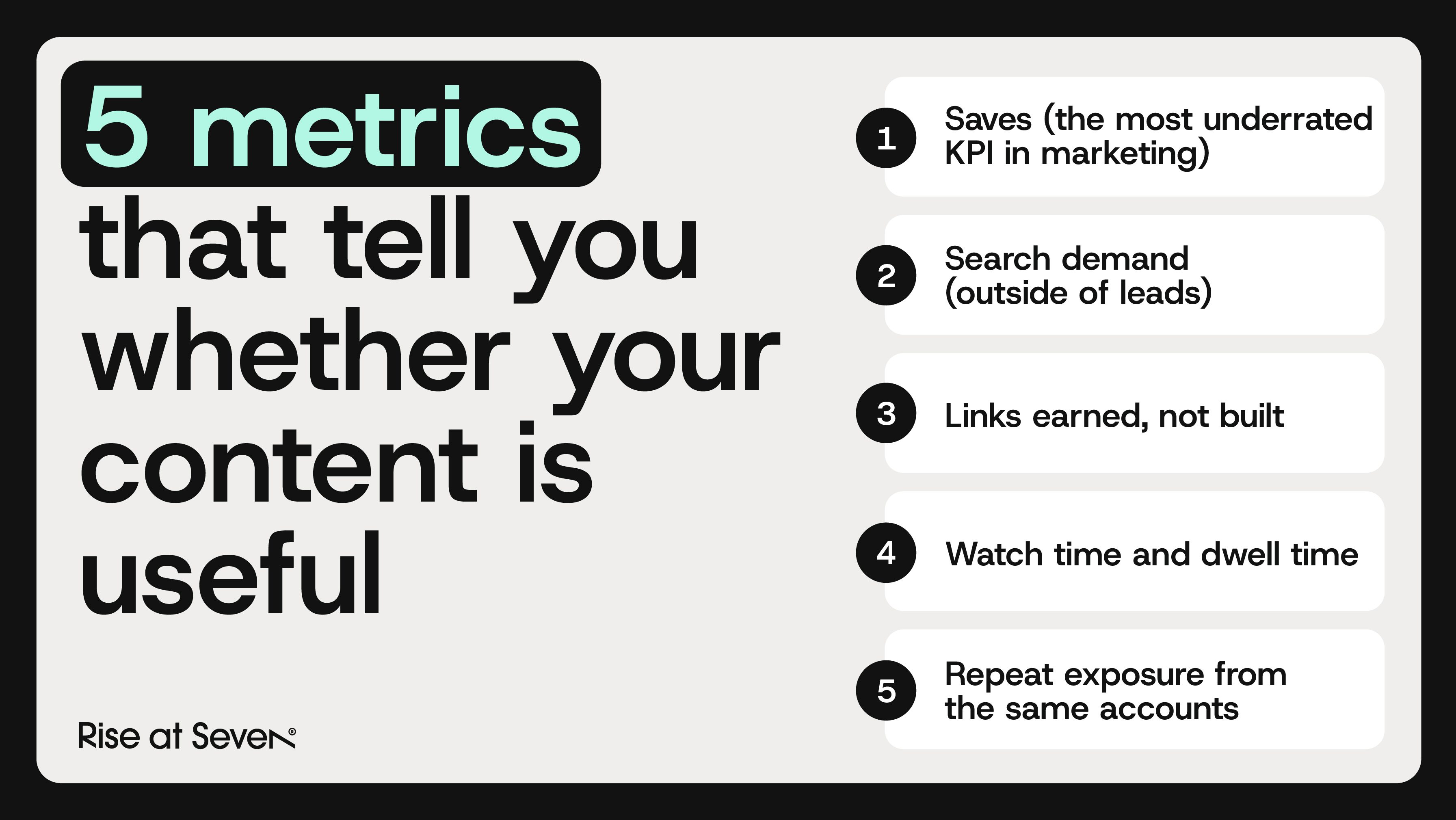
1️⃣ Saves (the most underrated KPI in marketing)
When someone saves content, they’re saying:
“This helped me. I want to come back to it.”
That’s intent - not vanity.
Likes are frictionless. Impressions are inflated. Saves are deliberate.
Social algorithms increasingly weigh this behaviour because it predicts future value, not momentary attention.
Example: the below videos all rank pos 1 on TikTok search.

These all have high save counts - meaning it was useful and people wanted to save it for later and come back.
Not only that but all of these have high share counts too. Looking at the whole social search results for these queries, they don't have the highest likes (not small anyhow), but the highest saves which is a signal of usefulness.
Read about how we did this for Parkdean Resorts and Dermalogica for skincare
2️⃣ Search demand (outside of leads)
Leads are a lagging indicator.
The real question is:
Are people actively searching for your brand alongside the product or service you sell?
If not, you haven’t earned mental availability yet.
Search demand tells you whether you’re winning before the buying moment.
3️⃣ Links earned, not built
How many links are you earning each quarter?
Not built. Not requested. Earned.
Links are a public signal of usefulness - and a key driver of visibility in both Google and LLM-driven discovery.
People don’t link to “fine” content. They link to content that saves time or explains something better than anything else available.
Example case study:
One of the best B2B case study examples of useful content is this a statistic piece we did for tooltester.com.
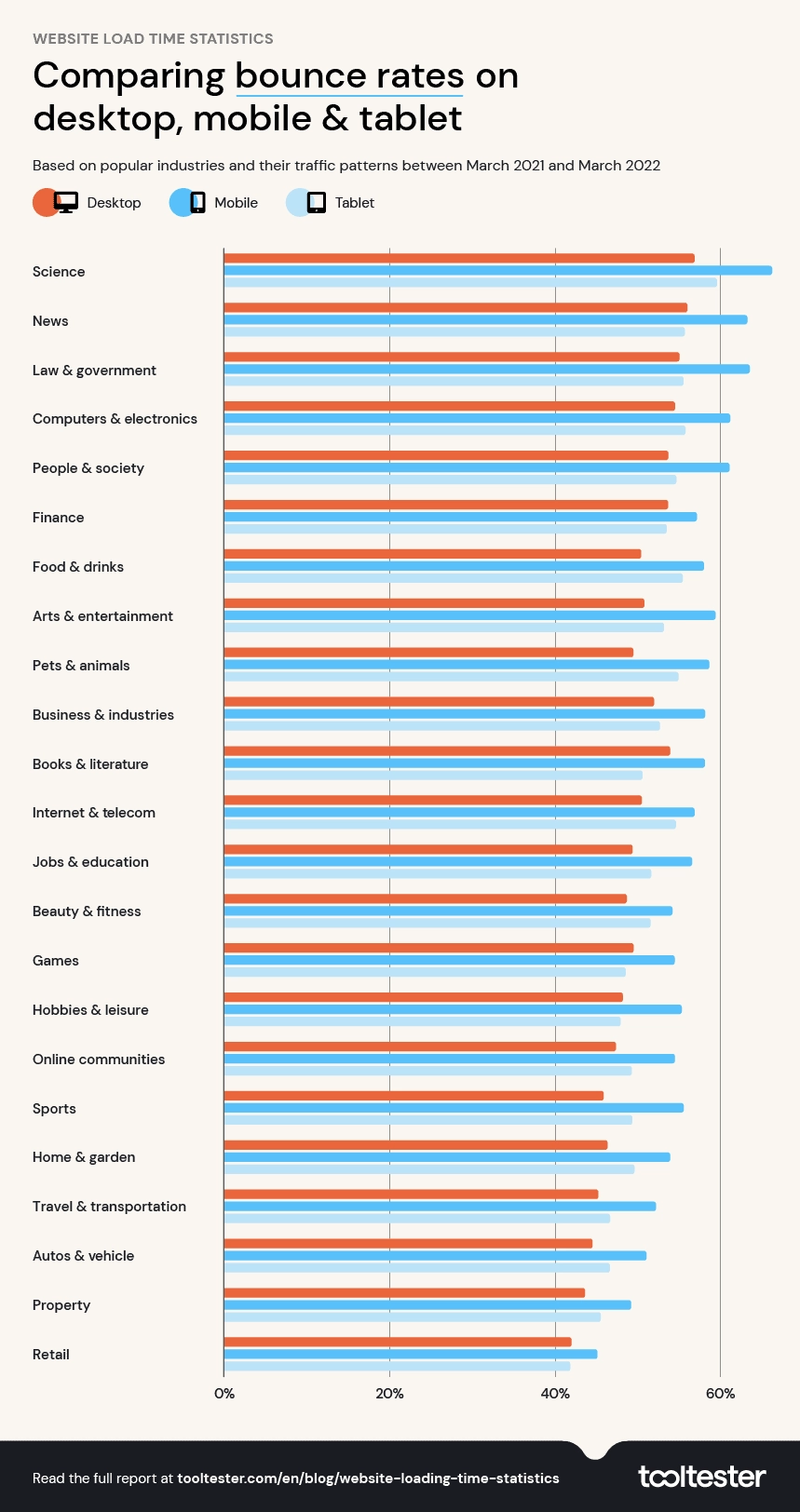
As a website building service, we compared website load and site speeds across industries and around the world. The statistics formed an in-depth piece around how fast a website should load, extremely useful for developers, business owners and technical teams making decisions and wanting to be educated.
This wasn't a clickbaity headline piece, it was purely useful and over the last 4 years has EARNED over 1000 linking domains from some of the biggest sites in the world including Shopify, Hubspot, Paypal and many more.
As a result of its usefulness, Google has ranked it. It ranks pos 1 for "website load speed statistics” and 30 other keywords on page 1.
4️⃣ Watch time and dwell time
Did people actually consume what you made?
Depth beats reach every time.
Watch time, dwell time and replays show whether your content delivered enough value to hold attention - not just earn a click.
5️⃣ Repeat exposure from the same accounts
If the same companies keep seeing, saving and engaging with your content, that’s not awareness.
That’s memory building.
And memory is how B2B buying decisions are made.
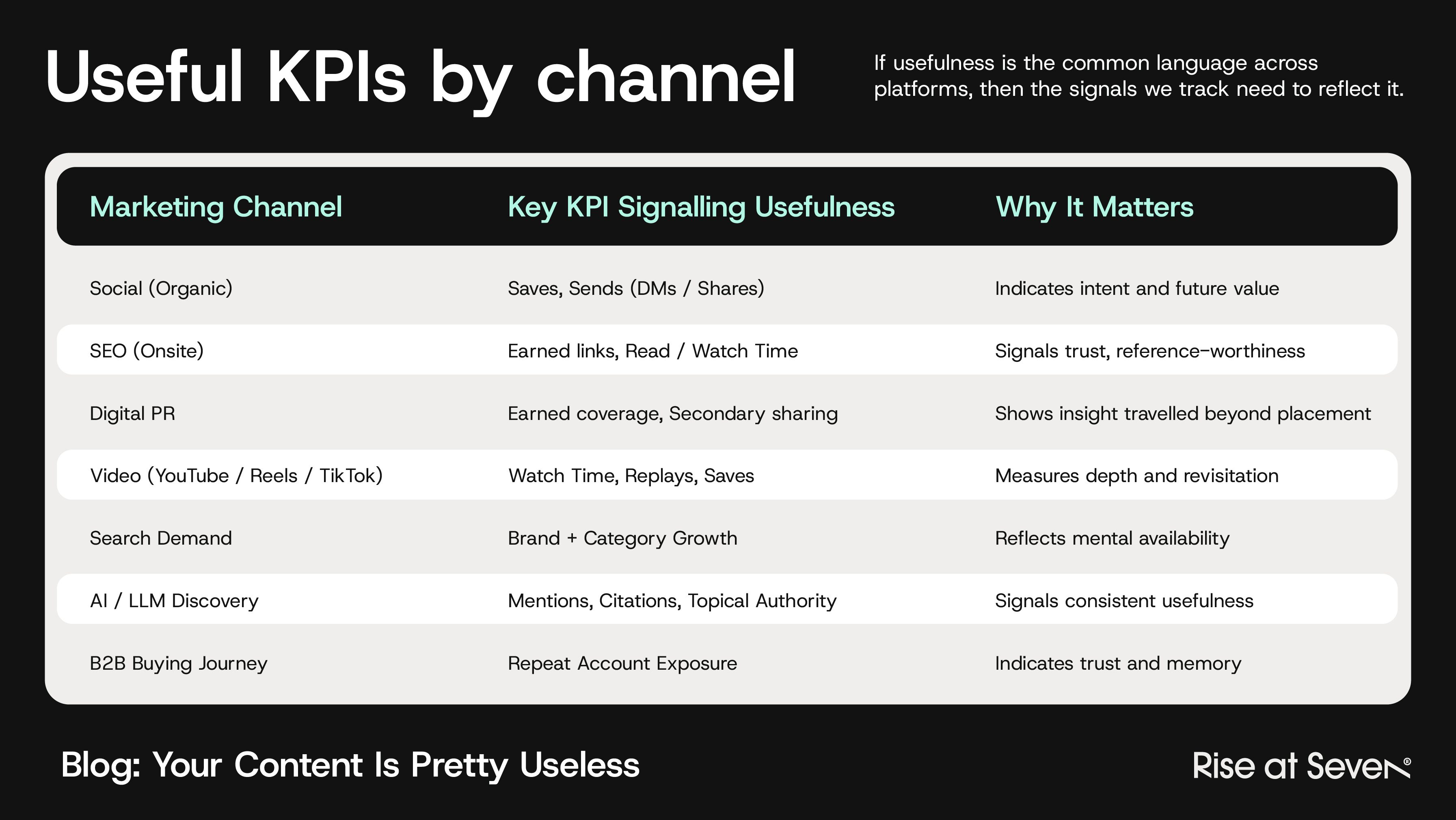
Useful KPIs by channel
If usefulness is the common language across platforms, then the signals we track need to reflect it.
Google is already scoring you on usefulness
This isn't my opinion. It’s how modern search works.
Google runs a dedicated ranking system designed to identify and devalue content created primarily to rank, rather than to help a user:
- complete a task
- answer a real question
- make a decision
This is what’s widely referred to as the Helpful Content Update - and it’s not a one-off. The most recent standalone Google Helpful Content Update was completely rolled out by 28 September 2023. This update refined how the helpfulness classifier judges content across the web - focusing on depth, originality and real value.
Before that, Google had two earlier rollouts in August 2022 and December 2022.
And then in March 2024, Google integrated the Helpful Content System into its core ranking algorithm, making these signals part of the foundation of how search works.
So while Google no longer announces isolated “helpful content updates” as frequently, the core concept lives inside the algorithm today.
It’s a system that’s been refined, reapplied and strengthened repeatedly over the last two years.
Crucially, it does not measure:
- Keyword coverage
- Content length
- Publishing frequency
- “SEO best practice” in isolation
Instead, it looks for people-first signals.
Usefulness.
That’s why its impact has been so severe.
Brands haven’t lost visibility because they “did SEO wrong”, but because they scaled content that:
- Answered keywords, not real questions
- Repeated what already existed on page one
- Added no original insight, experience, data or point of view
Here’s the part most brands still misunderstand:
Google doesn’t just evaluate individual pages. It evaluates site-wide content behaviour over time.
If a website consistently publishes content that lacks depth, originality or first-hand experience, Google applies a classification signal at brand level - not page level.
That’s why:
- Deleting a few “bad” pages rarely fixes performance
- Refreshing titles doesn’t reverse declines
- Entire domains can be suppressed even when individual pages look “fine”
Google is asking one simple question:
“Is this a brand that reliably produces content people find genuinely helpful?”
If the answer is no - at scale - visibility disappears.
So what KPI’s indicate whether the content is helpful/useful (and not useless?)
We've discovered the pattern is obvious.
Most content:
- Isn’t read
- Isn’t referenced/linked to
- Isn’t shared
- Isn’t remembered
And the content that does break through?
BuzzSumo’s research consistently shows that content containing original research, unique data or genuinely new insight earns significantly more:
- Shares
- Links
- Coverage
The internet doesn’t reward “more”. Which the industry seems to favour with uptake of AI processes. But what it actual;y rewards is… useful.
The same usefulness signals now power every platform
This shift isn’t isolated to SEO.
Once likes, impressions and follower counts became easy to game, platforms moved toward behavioural signals that indicate real human value.
Different platforms. Same logic.
Which brings us to the metrics that actually matter.
What the data tells us about saves (specifically)
Platforms aren’t subtle about this shift.
- LinkedIn now surfaces Saves and Sends as core engagement metrics
- Saves and shares carry more algorithmic weight than likes
- Educational and carousel formats generate the highest save rates
- TikTok prioritises saves and shares as relevance signals
- Private engagement is growing faster than public engagement
📊 Benchmark:
Content with a save rate above 2% of reach significantly outperforms lower-save content in future distribution.
A 2%+ save rate is now a meaningful usefulness benchmark.
The strategic takeaway: what to do next
This isn’t a call to “make more content”.
It’s a call to change how content decisions are made.
If you want to win in search, social, PR and AI-driven discovery over the next 3–5 years:
- Stop measuring output. Start measuring usefulness.
- Fewer pieces. Deeper thinking. Clearer points of view.
- Build content people would save, reference, or send internally — not just scroll past.
- Invest in original insight: research, data, experience, perspective.
- Treat content as an asset that compounds - not a calendar obligation.
Because the internet doesn’t reward volume anymore. It rewards content that’s worth finding, worth returning to, and worth remembering.
Useful content compounds.
Everything else gets filtered out.


