Key Differences Between Digital PR in Spain and the UK (And How to Win in Both)
Digital PR in Spain
Share
Key Differences Between Digital PR in Spain and the UK (And How to Win in Both)
Globalisation has blurred borders for audiences, but PR still behaves very differently market to market. The UK and Spain both reward entertaining, lifestyle-led stories - but how you earn coverage, trust and links in each country is a completely different game.
Audience interests and content style
Spanish audiences consistently engage most with entertainment, sport, lifestyle, food and culture. Technology and finance stories tend to underperform unless they’re made highly relatable or human.
To land coverage in top-tier Spanish publications, campaigns need to lead with emotion and strong visuals, while still holding up journalistically. Think: culturally relevant hooks, human insight, and clear storytelling - not overly technical or SEO-led narratives.
Tip: If your campaign wouldn’t work as a strong Instagram post or front-page visual, it’s probably not right for Spain. Start with the emotional hook, then layer in the data.
Linking behaviour is more selective
Unlike the UK, Spanish journalists are far less likely to include links by default. Links are only added when the content clearly enhances reader value - particularly through original data, insights, or genuinely useful resources.
Tip: Don’t ask for links upfront. Focus on earning them by offering exclusive data, region-specific insights, or downloadable assets that clearly improve the article.
A highly regionalised media landscape
Spain’s media ecosystem is strongly regionalised. While national publications exist, much of the influence sits within autonomous communities, each with their own trusted newspapers, broadcasters and online titles.
“While national outlets exist, much of the press is divided across autonomous communities, each with its own influential regional newspapers, broadcasters, and online media.” - Ines Mbae Lopez, International Digital PR Associate
Tip: National-only strategies underperform in Spain. Map regional relevance early and localise angles, stats and spokespeople wherever possible.
Digital PR is still maturing
Digital PR is still relatively early-stage in Spain compared to the UK, where it’s now mainstream. As a result, journalist relationships matter more, and outreach often needs to be slower, more personalised and more educational.
Many publications also still operate with a traditional PR mindset, with some expecting pricing information or commercial context before publishing.
Tip: Plan for longer lead times. Success in Spain compounds - early relationship investment leads to faster turnaround and stronger coverage later.
Pace, culture and working rhythms
Culturally, Spain is more relaxed and informal than the UK, shaped by alternative working hours and long midday breaks. This carries over into the media landscape: there’s less urgency to publish quickly, and fewer reactive news cycles.
Compared to the UK’s fast-paced, turnaround-driven environment, coverage in Spain simply takes longer to land.
Rather than forcing UK-style speed onto the Spanish market, we treat slower turnaround as a strategic advantage. By investing in journalist relationships and cultural understanding early, we’re able to unlock stronger coverage, better goodwill and quicker results over time.
Bottom line: UK digital PR rewards speed, scale and sharp news hooks. Spanish digital PR rewards patience, emotion, localisation and relationships.
Winning globally means respecting both - not copy-pasting tactics across borders.
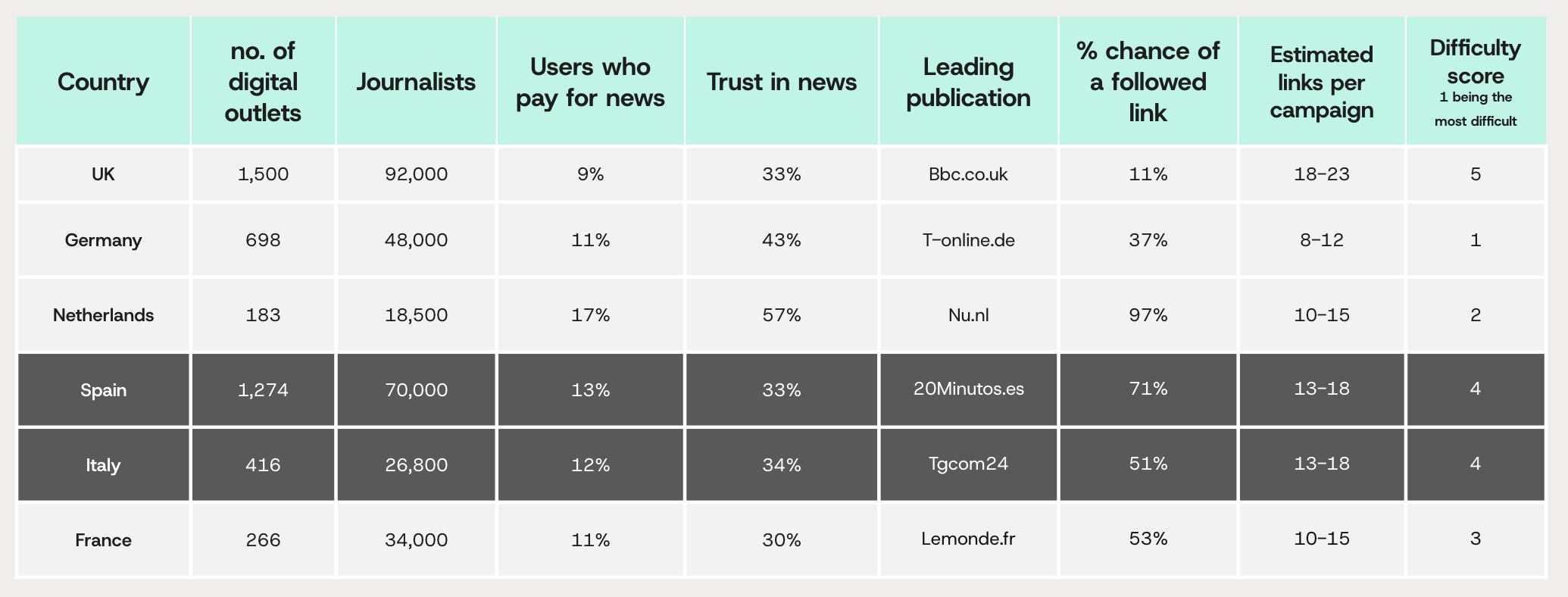
A global comparison of Digital PR in Spain vs UK, Germany, Netherlands and more....
Despite having fewer digital outlets than the UK (1,274 vs 1,500), Spain operates with a much higher likelihood of followed links (71%), significantly outperforming the UK’s 11%. This reinforces a critical difference in Digital PR strategy: Spain rewards depth and value over speed and volume, while the UK prioritises scale and rapid turnaround.
At the same time, Spain sits mid-pack for overall difficulty (4 out of 5), meaning results are achievable - but only when campaigns are culturally and structurally aligned to how Spanish media actually works.
Spain vs UK: fewer links, but better quality odds
The UK remains the most saturated PR market in the dataset:
1,500 digital outlets
92,000 journalists
Highest estimated links per campaign: 18–23
But the lowest chance of a followed link: just 11%
Difficulty score: 5 (hardest market)
This shows the UK is a high-output, low-certainty market. You can generate volume, but link equity is inconsistent and competitive pressure is intense.
Spain, by contrast:
Delivers 13–18 links per campaign
With a 71% chance those links are followed
And a lower difficulty score (4)
Translation: fewer total links than the UK, but materially stronger SEO value per placement.
Trust, payment and why Spain behaves differently
Only 13% of Spanish users pay for news, similar to Italy (12%) and France (11%), and well below the Netherlands (17%). This pushes Spanish publishers to prioritise traffic-driving, visually compelling and emotionally resonant content, rather than paywalled analysis or heavy technical reporting.
Trust in news in Spain sits at 33%, identical to the UK - but unlike the UK, Spain’s linking behaviour is far more deliberate. Links are added when they genuinely improve the article, not as a default citation.
This explains why:
Link rates are higher
Turnaround is slower
Relationship quality matters more than pitch velocity
Regional scale, national impact
Spain has 70,000 journalists, nearly rivaling the UK’s 92,000 - but spread across a highly regionalised media ecosystem. While Germany and the Netherlands centralise authority through fewer, dominant publishers, Spain’s influence is fragmented across autonomous communities.
This makes localisation non-negotiable:
National-only campaigns underperform
Region-specific angles increase pickup and link inclusion
Long-term journalist relationships materially improve speed and consistency over time
The wider European context (why Spain matters)
Looking across the table:
Netherlands is the easiest market (difficulty score 2) with a 97% followed-link rate
Germany offers the lowest difficulty (1) but lower link volumes (8–12 per campaign)
Spain and Italy sit in the sweet spot: strong link probability + scalable volume
UK remains the hardest, most competitive market despite high output
Spain is one of the strongest “quality link” markets in Europe - if you’re willing to slow down and play it properly.